

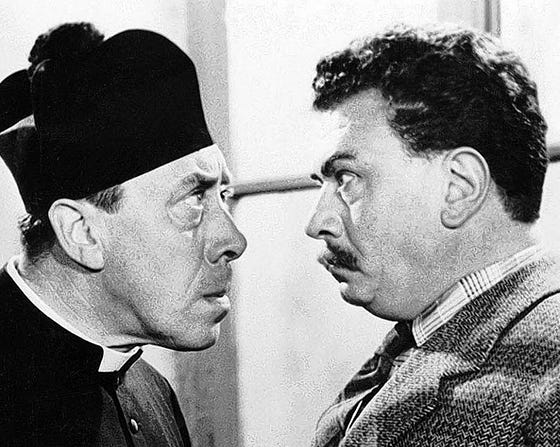
“When you share your last crust of bread with a beggar, you mustn’t behave as if you were throwing a bone to a dog. You must give humbly, and thank him for allowing you to have a part in his hunger.” Giovannino Guareschi
American satirical website, The Babylon Bee, most Sundays posts a link with the headline “Report: Go to Church You Heathen”. The link tells us:
“The data is clear, and the science has spoken,” said one expert who helped run the study underlying the report. “You are not at church, and it is the Lord’s Day, and you should be at church”
From a bunch of avowedly Christian comedians this is both funny and on point. For the target audience, you and me who lie abed most Sunday mornings farting about on our phones, the message is inoffensive, just a reminder that going to church is an option every Sunday morning. It also points us towards the truth that our society and culture, regardless of how much effort the likes of Alice Roberts put into telling us otherwise, owes most of its nature to Christianity. The West, as we like to call it, is indistinguishable from what past generations called ‘Christendom’. When Kenneth Clark wanted to stand outside something symbolic of civilisation, he stood outside Notre Dame cathedral in Paris saying something like “I can’t define civilisation but I know it when I see it”.
Despite being a lousy Christian, I like this sentiment. I like that we are still bothered about God and our eternal souls. I like that Christianity runs through our civilisation like a stick of Brighton rock. Even today the central themes of Christianity are familiar to almost everyone in The West, and Christ’s birth, death and resurrection continue to be marked, albeit more with chocolate and a roast dinner than on our knees in church. Every little village in the land will, at some point in December, put up lights, sing carols and share the blessings of the Christmas season. It is nonsense to say that we are cancelling Christmas because some local council or other public body got all hesitant about using the actual word ‘Christmas’ (Bradford calls its Christmas market a ‘winter market’ for no obviously good reason, for example something that sits alongside its multifaith tree).
Some folk, however, have got their knickers well and truly twisted over this Christmas thing. Whole conspiracy theories are concocted about the lights on the tree, donated by Norway each year, in Trafalgar Square, and news reports are trawled to scrape up any and all offence against Christmas. All while most people are planning their celebration, wishing happy Christmas to all and sundry, doing what past generations have always done at the anniversary of Christ’s birth. The problem is that now the whole Christianity thing has become a platform for a lot of what can only be described as political cosplay. Instead of just saying ‘go to church you heathen’, these politicians choose instead to do very public displays of Christian worship with, in the case of Sarah Pochin the Reform MP, professional cameramen taking film and photos of them performing their Christianity.
Elsewhere Tommy Robinson organised a carol concert. Not in a convenient church or village hall like a normal person but in Whitehall. Here Tommy was joined by a veritable horde of Christian cosplayers ranging from vicars of churches you’ve never heard of through so-called ‘citizen journalists’ to the sort of street preacher who opts for provocative confrontation in the hopes of getting arrested rather than, like the nice man on Briggate in Leeds, simply proclaiming the word of God. Of course, with all those people playing ‘dress up as a journalist’ at the event there’s plenty of social media footage. If you’d hoped that this footage would feature something about God and how he gave of himself to become flesh so as to save mankind then you’d be disappointed. Instead we get the, now familiar, litany of how Christianity in Britain is ‘under attack’, how the King is too nice to Muslims, and that the Government is trying to stop them from worshipping. All of which is twaddle but which these performers try to validate by pointing at any and every public example of Muslim prayer with the suggestion that there’s hardly a street corner in the land without Muslims praying (I’ve lived in Bradford for nearly 40 years and, in Britain’s most Muslim city, have never seen Muslims praying in the street).
Between Tommy Robinson using Christian worship to further his essentially anti-Muslim political campaign and Sarah Pochin’s almost pharasaical narcissism in co-opting a carol service to promote a pious image of her reverential worship, what we see are attempts to use Christianity, or at least the symbolism of Christianity, as tools in political campaigning. And while God and politics do mix (and God may well be an Englishman) the services we hold to worship and praise God should not be places of performance. If a politician, right, left or centre, tells us he or she is a Christian that is good and welcome. And we know that some politicians, Kate Forbes, Tim Farron and Wes Streeting have been attacked, often unpleasantly, for their public proclaiming of Christian faith. But none of these people did as Pochin and Robinson have done, tried to co-opt Christianity into their political offer through the exploiting of worship and praise.
It is right and proper that Christians should respond with vigour to unpleasant, largely ignorant attacks from media-friendly atheists and humanists. Humanists and atheists often turn directly to accusations that a politician is involving God in something entirely secular (like assisted suicide, abortion or marriage) and Christians should be robust in pushing back against this idea. But the new generation of public Christian, the sort with ‘Christ is King’ in their social media biographies, aren’t pushing back at atheists but rather at the presence of non-Christians and especially non-Christians whose skin colour is darker than a flat white. Tommy Robinson’s carol concert was intended more as an assertion of Christian supremacy than as an attempt to restore the public celebration of Christmas (something that never went away). The cosplaying vicars and preachers at Robinson’s show, just like Sarah Pochin with her camera crew, were performing a political act designed for social media, not a sincere act of praise for God and the imminent anniversary of his son’s incarnation.
The response, where there is one, from the churches is little more than a polite shrug or perhaps a moderate grumble about it all being a bit tacky. But there’s a need to guard against the sort of faux-Christianity displayed by these politicians, to avoid the sort of politicising of personal worship more associated with the USA, with Trump’s White House prayer breakfasts, Biden’s front row seats when the cathedral is full, and Clinton’s endless invocation of God in support of his message. Above all though, we need to guard against the supremacism associated with the nationalist right’s adoption of Christianity. A supremacism that leads to attacks on Jews, Muslims and even other Christians. If being a Christian gets associated with one political outlook (I appreciate here that the likes of Alice Roberts already hold this view in that they see liberalism as inherently atheist), this does nobody any favours, least of all the churches themselves.
Being a Christian should not be a political statement in a Christian country. That some seek to do just this must be resisted, whether it is Tommy Robinson, men who like dressing up as priests or a vain MP from a right wing party.
Sir, I read all of your essays and I generally love your perspective. However, "If you’d hoped that this footage would feature something about God and how he gave of himself to become flesh so as to save mankind then you’d be disappointed". I watched it all and I saw plenty of this. The ministers on stage preached theologically sound Christian doctrine. I also Robinson confessing that he is a sinner and needs the love of Jesus like all of us. Your broader points are all true and I get why you are saying what you are saying but if Tommy Robinson can be saved by Jesus then maybe there is actually hope for us this Christmas time.
Islam is as an old money religion in that its political and social aspects are a piece with its religious one. The West could say: look you can keep the religious aspects but not the political/ social ones, so eg all sex based segregation must cease, but the West does not have the conviction to say that, and so entertains a competing centre of power to those things western institutions pretend to think really matter in other contexts. It’s very weird.