

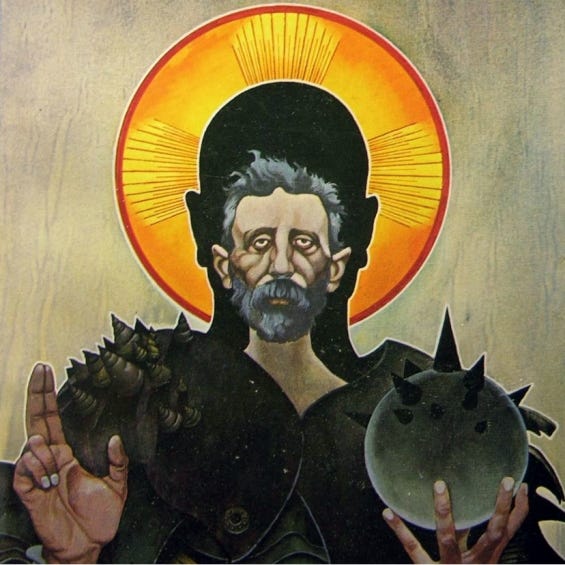
With the terrible and tragic murder of Anne Widdecombe we have been treated, often too publicly and from people who should probably know better, to a choice selection of “I’m glad she’s dead” statements and a veritable torrent of “I hated her and her politics but being murdered is bad” remarks. Most of this, because of Widdecombe’s politics, coming from the political left in its various guises.
Thinking about this, and the tragedy itself, I recalled a book published back in 1976 that tells the story of a wrathful god and his faithful followers. The book, “Deus Irae” by Philip K Dick and Roger Zelazny is about the pilgrimage, ‘pilg’ in the book, of Tibor McMasters, a disabled artist commissioned to create a likeness of the God of Wrath himself. His priest, Father Handy, near the start of the story presents us with his idea:
“De mortuis nil nisi malum, he thought, correcting the old saying to make it come out the more wisely: Of the dead only speak evil. Because they were that stupid; it was cretinism carried to the dimension of the satanic.”
When Father Handy corrupts the Latin tag about not speaking evil of the dead, he does so because the choices of those millions now dead led to the destruction he sees around him. Those dead men and women didn’t deserve him indulging the vanity of not mentioning their sin. Like most post-apocalyptic stories, ‘Deus Irae’ sets out to both imagine how a world after cataclysm would appear and to explore how human vanity, our hubris, created the mess in the first place. And in upsetting the old presumption about the dead, one dating back thousands of years, Dick & Zelazny make us think about why we are advised not to speak ill of the dead.
The most obvious answer to this question is that the dead, being dead, cannot defend themselves from accusations and allegations. So speaking ill of the dead becomes unfair since that dead person cannot rise out from their grave to set the record straight. The problem is, however, that we routinely criticise the dead. The entire study of history would be challenging if there weren’t criticisms, attacks and condemnation of people now dead. We also know that, when a revered ancient is condemned there are plenty of others prepared to step up and defend that revered ancestor’s choices, decisions and actions. We may be angry at Daryl Cooper calling Winston Churchill ‘evil’ on a podcast but our response isn’t to deny Cooper the right to make such claims but instead to explain why he is wrong.
The stricture not to speak ill of the dead is, at its heart, a matter of respect. Which is why Father Handy felt able to speak only evil of the millions dead in a human-wrought apocalypse: he could not respect them since they allowed the ‘God of Wrath’ to lead them to destruction. In our world there is no self-appointed god-figure leading people to their doom so we see the dead and ask if they earned our respect. This is not a matter of agreement or approval: when Tony Benn was asked why he went to Enoch Powell’s funeral his simple answer, ‘he was my friend’, wasn’t a statement approving of Powell’s politics but that Benn, having known the deceased for many years, respected him and his memory. There was no endorsement of views or actions, just a recognition that the newly dead person merited a moment of reflection and thanks.
It isn’t that we shouldn’t ever speak ill of the dead but rather that we should, at the moment of a person’s death, be reflective and considered. Above all we should remember that the deceased had family, friends, a wife or husband, children and these people are hurt by that person’s passing. The rawness of that moment of loss should, in most circumstances, mean we hold back from criticism. Like many of you, I could write a short list of people whose death I would not mourn: some are public figures, others people I’ve known personally (a few are both). And, should those on this list go before me, there may be a time and context when setting out why I don’t mourn them is possible. But that time isn’t close to the time of the death itself and it isn’t usually a public forum. There’s a world of difference between saying “I really hated so-and-so” privately to your spouse or close friend, and sounding off in print or over the airwaves.
Father Handy was angry. We could say justifiably angry since the choices of millions to endorse the wrathful god resulted in those millions dying. But his anger wasn’t directed at the god himself despite that being the most obvious response. Instead his collapse of respect was in the shallowness, selfishness and hubris of those now dead millions. There will be times when a death seems just, American drones gunning down Osama Bin Laden might be one such an example. But for Father Hardy to opprobrium shouldn’t fall on Bin Laden but on the thousands, millions maybe, who made that terrorist’s actions possible. We can be grateful for the evil person’s demise but also recognise that all of the crimes associated with that person are also the consequence of choices made by others, ideas formulated elsewhere, and support given for reasons of ideology, search for power or just pretending you have the authority of God.
Although there is something of a contradiction in humanity, we are both individually creative and creatures of what has gone before, when someone chooses to attack someone recently deceased, to call them mad or bad or evil, this creates an unanswered cruelty: the critic is the evil one, the person at fault, because despite the object of their criticism (in Father Handy’s case the God of Wrath, Carleton Lufteufel) being individually evil, that is only possible because humanity contains a collective evil. As Professor Heinz Kiosk, Michael Wharton’s crazed psychologist, would put it; “we are all guilty!” This is why we don’t speak ill of the dead, why as someone’s friends and family mourns we keep our thoughts to themselves. There will come a time when criticism is merited but nearly always there is no justification for publicly dancing on the newly dead person’s grave.
Philip K Dick and Roger Zelazny’s exploration of faith, doubt and genius finishes with Tibor McMasters, seventeen years dead, celebrated for the great art he created. Tibor is a saint despite us knowing that his commitment was to his art not to the painting of god they had commissioned him to produce. You cannot speak ill of the saint, to do so would be heresy. We are left hoping that the chance to speak ill will come, not for the sake of it but for the sake of humanity.
“It was indeed the visage of the God of Wrath, Carleton Lufteufel. There could be no doubt. Any disputing this was henceforth illegal…This was to insure reverence in an irreverent world, faith in a society which had become faithless, and belief in a world which had already discovered that most of what it believed were in actuality lies.”
Beautifully written Simon, thank you; "He was my friend", nothing more to be said.