

The rhetoric is great, the excitement (at least among the political cognoscenti) is palpable but as I’ve observed before what we’re offered isn’t devolution or genuine local control over anything much beyond the colour of the buses. And it seems, if the turnout for the Greater Manchester Mayoral by-election - a mere 25% - is any guide, that the public has twigged this truth.
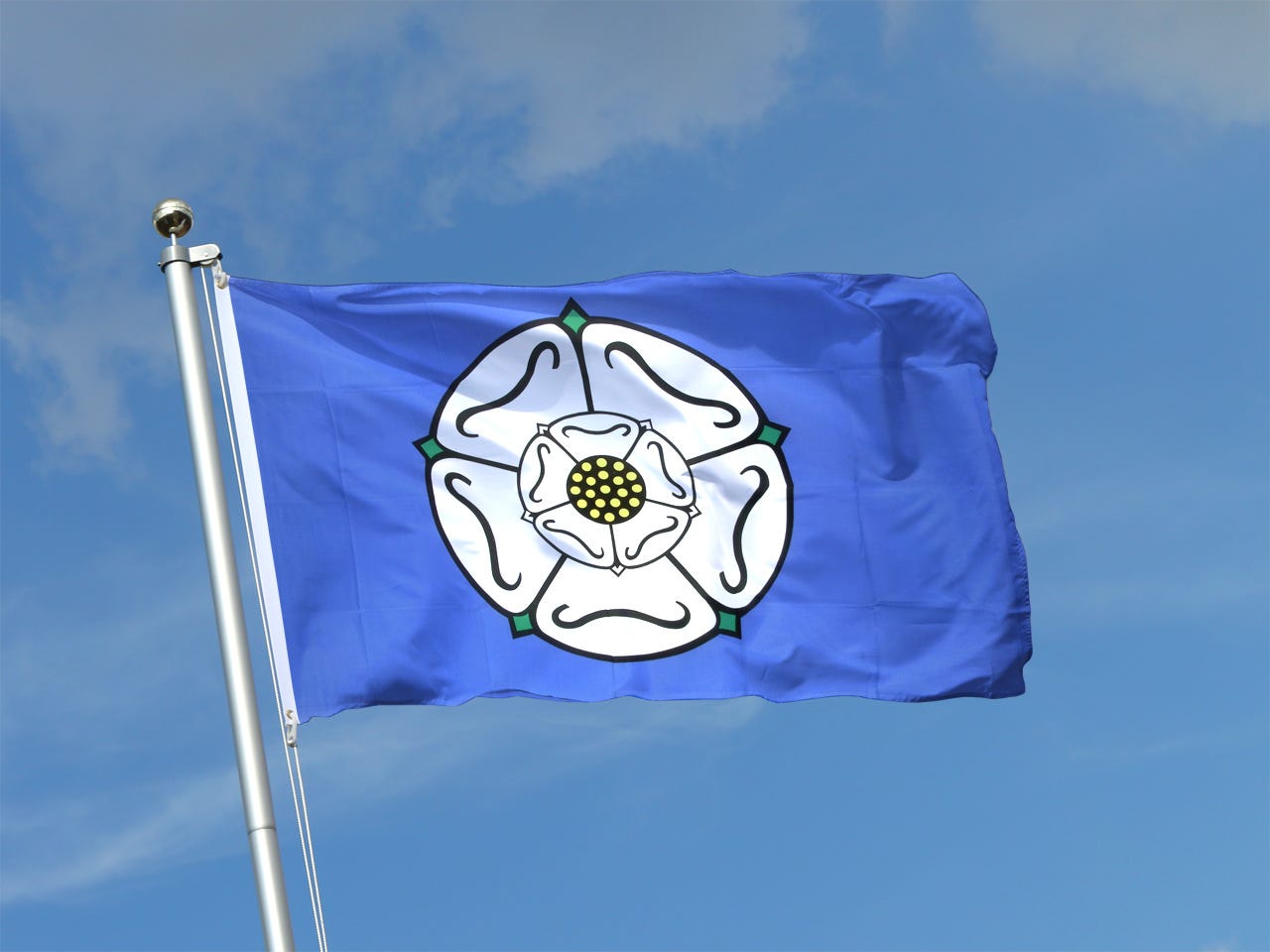
Today, 1st August, is Yorkshire Day when people across the broad acres smile at their good fortune while others look on in disappointment at not being in or from Yorkshire. The whole of Yorkshire, from Hull to Huddersfield and from Settle to Sheffield now has these new-fangled ‘Mayoral Authorities’. Some like West Yorkshire and Hull & East Riding have a modicum of geographic coherence but York & North Yorkshire encompassing everything from Sutton-in-Craven to Scarborough is a historical and geographic catastrophe. Other than both places being in Yorkshire it is difficult to see how this makes sense except as “all the bits left over”.
Worse than this though, we’re being sold a fake devolution. Compared to pre-1972 local councils, these ‘Mayoral Authorities’, have almost no say over how much they have to spend and what they get to spend it on. For all Andy and Tracy tell us about ‘new powers’ and ‘new money’, the reality is that these elected mayors run the public transport authority and administer regeneration funding given to them by Whitehall. A few of the Mayors have the role of ‘police and crime commissioner’ which means they have no control over the police or crime but collect the rates that, in part, pay for the police and fire service.
The Mayors can’t issue bonds, can’t borrow money, they might be getting 25% of income tax but on Whitehall terms it isn’t their money to control. And those mayors don’t run any of the services of local councils, they just get to boss those councils around because they control the bits of central government capital and grant funding that relate to regeneration, highways and skills. The Mayors don’t control how much of this money they get to spend, don’t control which schemes they’ll fund, can’t raise their own tax to supplement this money and can only conclude investments with the signature of the relevant minister down in London - perhaps secured when that person toddles up north to the pointless piece of posturing that is “No 10 North”.
This is not devolution, this is the illusion of devolution. It is Whitehall using Mayors to give a regional accent to decisions that, in the end, are made in London. This might be the right way to run decision-making in England but it really isn’t devolution. I know it isn’t devolution because I can look a little further North and see something in Scotland that looks a load more like actual devolution (I appreciate there are Scots, not all nationalists, who think even their extensively devolved government is still faux-devolution). I can also look elsewhere, to Spain, Italy or Germany and see countries where decision-making is spread across local, regional and national governments. Even better, and unlike our elected mayors, these places have elections for assemblies that hold the executive leaders to account. In England it is just a cosy little club of unelected council leaders and carefully selected business representatives usually from the same party as the mayor.
If we want devolution (I’m not so sure we do) we should be electing regional assemblies responsible for a wide range of services across health, policing, transport and economic development as well as the power to raise the taxes to fund those services. Even in Scotland, the desperate urge of Whitehall to keep control, creates a situation where that nation’s leaders can blame Whitehall rules and (lack of) funding for their own inadequacies. And vice versa.
I don’t believe that devolution - even actual devolution rather than the fake English variety - leads to more economic growth. Yet this is the main argument we hear from its advocates. It isn’t clear that less centralised places than England necessarily have high rates of economic growth. What you do get is a slightly better distribution of that growth. As Tom Forth and the people at Centre for Cities are endlessly reminding us, France’s regional cities have enjoyed more growth than regional cities in England. Whether this is down to ‘devolution’ is moot but they do have the advantage of having local councils able to set and raise taxes, plan investment and, if necessary, issue bonds or borrow money. None of this pertains in English devolution, the mayors just get to paint the buses yellow, pink or green.
If we are serious about improving public administration maybe we should start by getting back to levels of local government independence last enjoyed prior to the 1972 reforms. The problem we face with local administration isn’t about devolving more things to localities, it is about the ability of localities to make their own decisions about what is right for that place rather than have Whitehall tell them what to do. When politicians in Westminster are deciding about the colour of recycling bins, whether to provide a food waste collection service and the methods for managing waste, it is hard to see that we gain much from giving a regional mayor half a say over road building and no real say at all over public transport infrastructure.
We’re being told that these devolution proposals are a radical transformation of public administration in England - all illustrated with twee videos of Andy Burnham talking about teacakes (or barms as he calls them). In one respect they are because we have a substantially different political geography but underneath that change nothing much is different. The new satrapies administered by elected mayors serve the policies and purposes of Westminster and Whitehall not local priorities or interests. Mayors can’t, for example, decide to have radically liberalised planning, lower business taxes, or a focus on energy abundance rather than Net Zero. The mayors can’t lead on building nuclear power stations or adopt a different approach to delivering health services. The mayors can’t even make decisions about investing in public transport (except what colour the buses should be). The mayors simply act as local agents for Whitehall in the same way that No 10 North isn’t radical let alone devolution, just Whitehall making Whitehall decisions in an office in Manchester.
English devolution is a mess. English devolution is an act of political smoke and mirrors. Above all, English devolution is a fake.
Most of this is very fair comment. Devolution as currently proposed is a drop in the bucket; although an improvement on devolution as implemented to date. The continued shackles on the ability to tax is the strongest case in point as highlighted in the article.
That all said, playing devil's advocate, if I were a Mandarin sat in Whitehall would I feel comfortable devolving real powers to local authorities: too many are run by councillors who speak of wanting halcyon days, but can't even deliver enough new houses for their constituents to live in. A place for a human being to shelter a.k.a. a house is the cornerstone of modern civilization. Despite this, they sabotage their local plan process to delay delivery of even relatively miniscule amounts of housing. Does this signal competence deserving of more devolution. Quite the contrary.
What would these authorities do if they were devolved, for example, energy policy: too many would probably ban all new energy projects within their boundaries to protect their so-called unique way of life. No fracking, no solar, no wind, no nuclear. Leaving what? Continued reliance on despots in the middle east to keep our lights on.