


When Michael Gove was Secretary of State for Education him and his allies described the educational establishment in Britain as The Blob:
“His explanation is that he is locked in a struggle with “The Blob” - the name he and his allies give to the educational establishment which is inspired by the 1950s film about an amoeba-like alien mass which nothing has been able to stop. Gove sees himself as a revolutionary fighting the Blob’s “progressive” grip over teacher training, classroom standards and qualifications.”
Gove and others saw an urgent need to break the grip of progressive ideas on schools, believing with some justification that these ideas were bad for educational outcomes and especially bad for working class and ethnic minority children. The Blob is, of course (as the policies of Bridget Phillipson and Lucy Powell demonstrate), still with us but stepping back from the politics for a second there’s no doubt that Gove’s reforms were a success:
“England is one of the best-performing countries in terms of school-age attainment. Over the past decade, the literacy and numeracy skills of 15-year-olds in England have improved significantly relative to other high-income countries. While England is middle-of-the-pack on inequalities, among the OECD only Canada, Estonia, Ireland and Japan manage to deliver both stronger average attainment and lower inequality than England.”
Education is not the only area of public policy where left-of-centre ideas that, despite being consistently wrong, persist in dominating the choices of our governments. Another Blob exists in housing policy where progressive ideas around social housing, accusations of speculation, public transport and the primacy of planning are so embedded in the system that even people who lay claim to the label YIMBY - “Yes In My Back Yard” - propose approaches determined by the Housing Blob’s essentially statist presumption. The same progressive arguments used against Gove’s free schools and academies are directed to private initiative in seeking to meet housing needs. The Housing Blob’s position is that only state action can close the gap between the numbers of homes being built now and the number of homes needed to meet need.
So it was disappointing to see Michael Gove, scourge of the Education Blob, endorsing a statement from the current Labour housing minister that is a summation of the Housing Blob’s attitude to private development in housing. Matthew Pennycook, the minister in question said this (in response to an article in the Financial Times setting out just how much of the cost of building a house is down to tax and regulation):
“As this piece aptly demonstrates, mainstream public discourse on housebuilding in England is almost entirely devoid of any meaningful consideration of the structural dominance of speculative development models.
The market absorption rate constraints inherent to those models (i.e. developers cannot afford to build and sell homes too quickly in any given local market as doing so would undermine prices and result in a loss on their land investment) mean that build out rates are tied to rising house prices and the existence of sufficient effective demand for homes at those prices.
It is not in dispute that viability pressures are acute in many parts of the country. That’s precisely why we’ve implemented a range of targeted regulatory easements and committed to no major new building regulations for the remainder of the parliament.
However, the simple fact is that the private market as it is currently constituted will not, on its own initiative, produce sufficient housing to meet overall housing need, even if it is highly competitive.
The disruption and transformation of the housebuilding market is essential to delivering high and sustainable rates of housebuilding in the years ahead.”
The FT article draws on some work from the Centre for Policy Studies on the housing market and includes this graph:
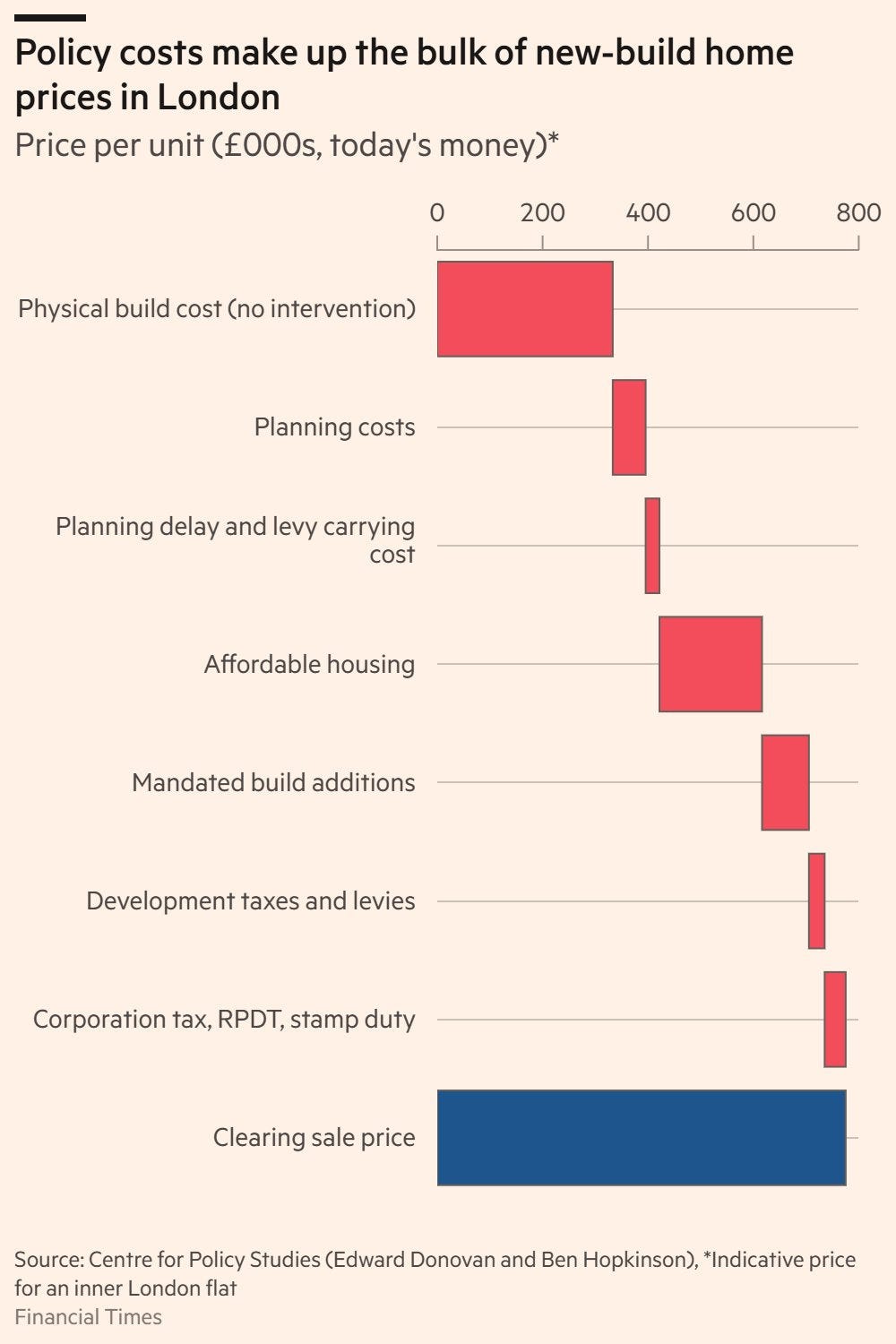
In response to work showing that nearly 60% of the cost to build a home in London is taxes, regulations and levies, the minister resorts to claiming that houses are more expensive because “...build out rates are tied to rising house prices and the existence of sufficient effective demand for homes at those prices.” This could be true but only in a market where there is no real competition either from other developers or the second hand market. Given that nationally only 20% of house sales are new build and for London the figure is just 8%, the idea that house prices are set by new build developers is nonsense. Yet this is the firm belief of the Housing Blob.
The presumptions at the heart of government, from housing writers and academics and from big housing organisations such as Shelter, the National Federation and the Institute of Housing, continue to set the wrong direction for housing policy by focusing on demand, council housing, managing rents and increasing the amount of “affordable” - typically social rented - homes. Attacks on ‘speculation’ are commonplace usually accompanied by claims about ‘land banking’. ‘oligopoly’, and ‘financialisation’. The Housing Blob points to the mass council house building programmes from the 1950s to the 1970s, arguing that this shows that only state direction, planning control and central funding can close the gap - a gap now over five million homes - between the housing we have and the homes we need.
The Housing Blob is attached to an approach that, given the parlous state of national and local public budgets, simply isn’t deliverable. The government has a National Housing Delivery Fund that plans to spend £40 billion over the course of a decade. This sounds like a lot of money until you realise how much it costs to build a house. Even if the state can dodge all of the extra costs in the CPS graph above a new home still costs at least £250,000 to build which means that this huge fund is going to build us just 160,000 houses (and this assumes there are no land costs and no real externalities like decontamination, highways and water management). Even if the £40 billion ‘levers in’ three pounds for every pound of state funding the programme still only delivers 640,000 homes across ten years for the whole of England.
Of course, what the Housing Blob then says is ‘Section 106’ means affordable housing mandates - up to 50% in some cases. Which sounds great except that we are certain that the additional costs from affordable housing mandates affect prices (by up to £13,000 per home some suggest) and, in doing so make many developments unviable, especially given the range of costs loaded onto developers in taxes and regulations. Here’s a list from Chief Economist at the Construction Products Association, Francis Noble setting out just how much the current British government is loading onto developers:
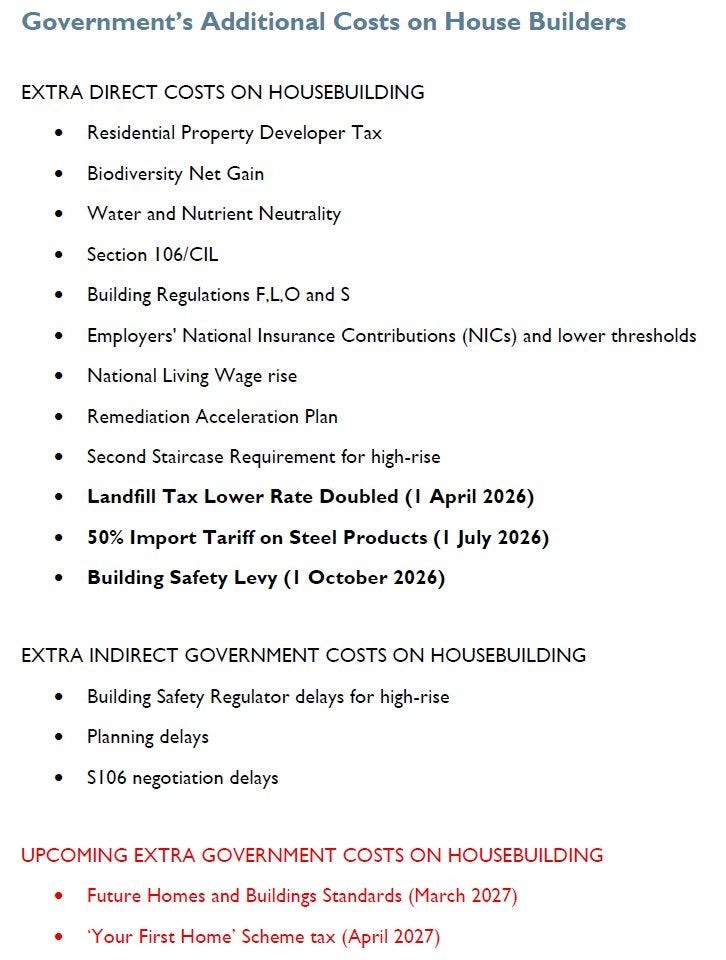
These recent additional costs are largely additional to the costs identified in the CPS study and suggest that, not only is up to 60% of the clearance price regulatory costs but the build cost itself is substantially increased by taxes, regulations and levies. As a back of the envelope estimate perhaps 80% of the price you pay for a new build house represents costs imposed on developers through regulation, taxes and levies.
Pennycook and Gove will get away with blaming the housing developers for the crisis because only a few people like the CPS and Francis Noble are looking in any detail at the way in which the cost of building a house is affected by the state. Pennycook is essentially making the same claim of housing developers as union leader Sharon Graham was making recently about supermarkets and, just as Graham was wrong, so is Pennycook. If there is a problem with the structure of Britain’s housing development market then that problem can be laid squarely at the door of our government - we have the system we have because only the firms with deep pockets and substantial assets can afford to carry the risks associated with building houses. In the 1930s when Britain built over 300,000 homes a year, there were over 70,000 developers building an average of 4-5 homes each. The sort of costs from regulation alongside the genuine risks of not receiving a planning permission after considerable costs mean that smaller builders funding their work from cashflow simply left the market.
In drawing up policy, the Housing Blob has a series of almost unnegotiable assumptions:
Planning should prioritise urban densification over suburban growth
New Towns are better than urban extensions
Social, especially council, housing is critical to meeting need
Planning and the discretionary system for permissions is not the problem
The regulatory system requires more funding so as to deliver housing targets
Planned large sites are better than unplanned small sites
Regulations like Community Infrastructure Levy and s106 are marginal to viability
Delays to planning approvals are the fault of councillors
House prices are determined by developers not the second hand market
All of these assumptions are wrong. The barriers to meeting housing need lies with the planning system itself, with the manner in which non-housing regulatory agencies and government departments have no interest in housing delivery, with three decades of decline in the construction workforce, and with a system more-or-less designed to prevent speculative self-build and small build.
In 2023 when Labour launched its YIMBY housing policy (albeit with a less than enthusiastic endorsement from the man who went on to be housing minister) it did so with a considerable amount of goodwill. Many people who had spent years decrying the failure of our governments to deliver new housing saw new hope with real planning reform and a degree of urgency in trying to meet the surging demand for homes. Today, as the minister and his boss, Angela Rayner, tell us their 1.5 million homes target ‘was always a stretch target’, we realise that there is no chance of the government delivering on the promise in made in its 2024 manifesto, indeed that their new taxes, regulations, costs and levies (plus a solid dose of inflation for construction materials) mean we will have among the lowest levels of new home construction on record.
It didn’t have to be like this. Genuine planning reform that made permissions easier and reduced the additional costs levied on developers was possible. We could have ended the discretionary system with a zoning system similar to the one the previous government had run away from. And we could have recognised that not only does demanding affordable housing make development less viable, the additional social housing we do get acts to make private rents higher by squeezing availability. Some of these choices would have been unpopular with the entrenched Housing Blob, with left wing NGOs like Shelter, and with the social housing sector’s spokesmen and women in the NatFed and Institute of Housing. But, just as Michael Gove stood up to the Education Blob, standing up to the state, academic and local council Housing Blob would transform both housing delivery and the private development sector.