

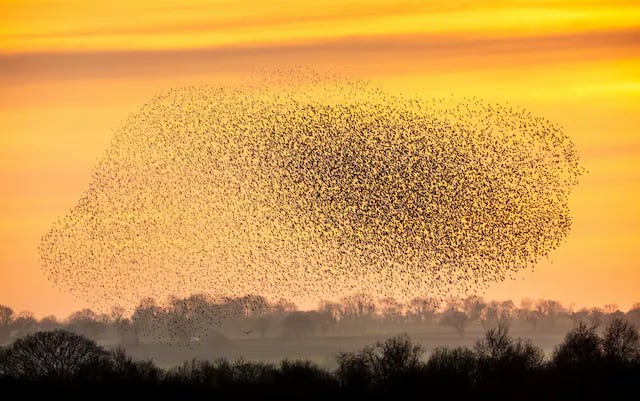
Hannah Fry, the maths and science influencer posted an interesting little video about murmurations, those incredible and spectacular aerial displays by flocks of birds (most commonly starlings). Fry asks how it is that during these displays the birds seem almost uncannily connected, almost as if there’s some programming preventing any collisions or crashes. Of course it turns out that the secret to the starlings’ display isn’t some central direction, leadership or planning but a simple set of rules followed by the birds: don’t get too close to the neighbouring bird, steer in roughly the same direction as that bird, and stay close (but not too close) to the group.
“Ultimately, Fry points out a beautiful philosophical and mathematical lesson: gorgeous, cohesive structures do not require a central leader. They emerge naturally when every individual quietly pays attention and adjusts their behavior to the people right next to them.”
Unsurprisingly this simple behavioural discovery helps our understanding of crowds and crowd management, hints at how viral spread (real viruses and information viruses) happens, and contributes to a variety of traffic management activities. When I watched the little clip I was, however, struck by another parallel which Fry doesn’t mention: the operation of free markets. We live in a world where many, including policy-makers and politicians, believe that free markets are an illusion and that there are people (often sinister conspiratorial people) directing markets usually to their benefit and our detriment. You only need to listen to left wing politicians talking about supermarkets or the buying and selling of government debt to hear this presumption of sinister management in full flow.
What the murmuration teaches us is that all these ideas of how markets are guided or directed - as wannabe prime minister Andy Burnham put it, we mustn’t be in ‘hock’ to the bond markets - are mistaken. The behaviour of markets is much more akin to the behaviour of starlings over the Somerset levels: buyers and sellers track what adjacent buyers and sellers do, they tend to track in the same direction, and they stick close to the pack. When we talk about market trading, we tend to mention the show off, willy-wagging world of online economics guru, Gary Stevenson. It is all about big bets and high risk strategies, it is a world of big swinging dicks, cocaine and burning the candle at both ends. And while there’s some of that going on, the reality is that most people trading in markets (including all of us when we go shopping) don’t take risks and, in broad terms, follow the herd. The corporate treasury manager acts more like George Banks and the Fidelity Fiduciary Bank than like an extra from “The Big Short”:
If you invest your tuppence
Wisely in the bank
Safe and sound
Soon that tuppence safely invested in the bank
Will compound
And you’ll achieve that sense of conquest
As your affluence expands
In the hands
Of the directors
Who invest as propriety demands
The second lesson from the murmurations is that the aggregate of individual decisions creates something beautiful and magnificent. So it is with markets, those petty choices and decisions we make seem like nothing much when they’re made but collectively they provide the bedrock for human betterment. The singular genius of Adam Smith was that he saw this truth - it gets called the ‘invisible hand’ - and that managing trade, at any level, limits and restricts that trade, encourages corruption and leads to crashes. It is a tragedy that the case for free markets and free trade has to be remade each generation. There will always be people like Andy Burnham who, either from personal ambition or misplaced conviction, tell a sceptical public that they can manage markets better. And these people are wrong. They were wrong when they argued for mercantile monopolies in the 18th century, wrong when they defended the corn laws in the 19th century, wrong when they claimed government should set prices by fiat, wrong when they claimed markets should be replaced by state direction and planning, and wrong when they claim economic growth comes from tariffs and industrial policy not from the glorious murmuration created by the choices millions of people make about their lives every day.
Today the happiest, healthiest and wealthiest places are, almost without exception, places where governments resist the temptation to interfere, to pretend they can direct the murmuration of the market. These places - Texas, Alberta, Denmark, Singapore to name a few - are not all alike and the patterns their markets make are not the same. But they succeed because they trust that people will not get too close to the next bird, will fly roughly in the same direction, and will accept the good sense of the collective. It is also a reminder that markets are not, have never been, about a sort of wild west individualism but are a reflection of human society.
So next time you see a film of a murmuration, or better still see one live, think about what these birds are doing. Then consider that the most beautiful and beneficial things humanity does - meeting our shared needs through free markets - works in a very similar manner. Your local big supermarket is a thing of beauty: over 35,000 different products brought to you at a convenient location and at affordable prices. This is what markets do, it is impossible to track or model every individual choice, to trace the work going into the most mundane of products but there on the shelf in Tesco is a can of baked beans for 40p. Humanity creates this magic collectively but that isn’t an argument for planning but a recognition that planning is futile and pointless. At best those plans will make no difference but too often they try to make birds change direction, drag them away from the crowd. The result is crash, chaos and the end of the market murmuration’s glorious beauty. Yet every day politicians and so-called activists tell us the beauty of the market is a sin, that they should be allowed to direct and manage the direction and choices of the birds in flight. And beauty dies, we stop getting healthier, wealthier and happier.
Lovely image but I don't think it works. You write that "buyers and sellers track what adjacent buyers and sellers do, they tend to track in the same direction, and they stick close to the pack". Is this really what we're doing when shopping? At a supermarket, I'm not paying attention to fellow buyers; I'm making buying decisions based on my individual needs, and my decisions are affected by the prices set by the shop. The shop's prices are adjusted in response to demand from the "flock" of buyers, but the information flow from other buyers to me via price signals is both indirect and non-local.
Burnham (and Starmer et al) is a 'man of system" as desribed by Adam Smith in his Theory of Moral Sentiments. As Adam Smith put it, each of us has a principle of motion of our own altogether different from that which the legislature chooses to impress on us.
Because people do not naturally conform to a rigid, top-down framework, the 'man of system' must eventually resort to force, control, and mandates to make their system function.
Why does this lesson have to be relearned again and again?