

“She’s a figure of myth. And I mean by that everybody for hundreds of years will know if you say, she’s a real Margaret Thatcher, they’ll know what you mean. An ism has been named after her. Her character’s very strong, her beliefs are very strong and this has been an enormously important part in the history of freedom in the western world and it’s seen and admired, and often criticised but nevertheless strongly admired across the world.” Charles Moore, Margaret Thatcher’s biographer
A few days ago the Japanese ambassador, accompanied as ever by a small Paddington Bear doll, visited Grantham and posted on his popular ex-twitter account some pictures of him at her birthplace and stood before Thatcher’s statue in the town square. Reading through the responses to the ambassador’s posts, I came to see that for many in Britain, Margaret Thatcher is, as Charles Moore observed, a mythical figure. And the mix of responses, half hate-filled and describing Thatcher in demonic terms and half loaded with praise of her strength and leadership, brought to mind an Irish goddess.
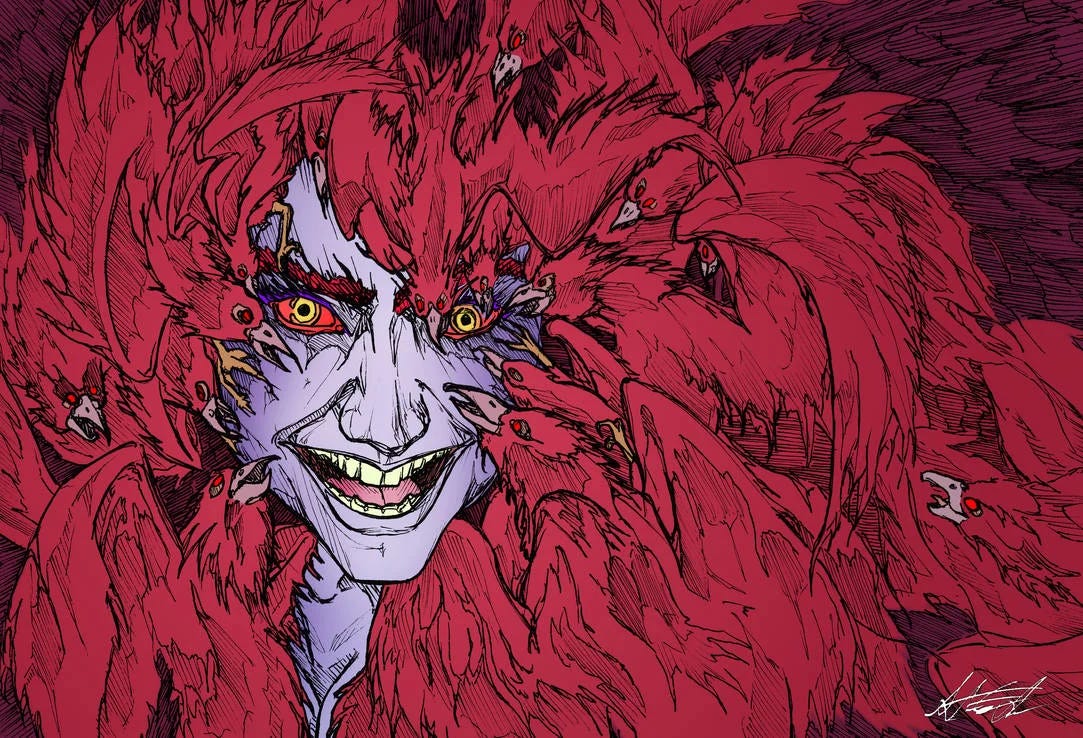
The Irish death goddess, Morrigan, is usually portrayed either as a hag or else as a glorious queen of battle. This reflects her two domains, albeit that death and battle are inevitably closely entwined. For some Morrigan is beautiful, dangerous and magnificent, the Queen of Battles, while for others she is evil, bitter and hateful, a Night Hag. These two images capture beautifully the responses to the Japanese ambassador. And reminds us that even now, over 35 years since she left office, the mere mention of Margaret Thatcher elicits such strong feelings, often from people too young to have experienced her period as prime minister. It is, however, the Mythic Maggie - either night hag or battle queen - that people address not the real Margaret Thatcher.
The first time I voted was in 1979 and, in helping re-elect a Conservative MP, I guess I contributed to Margaret Thatcher arriving at 10 Downing Street. At the time the motivation of many to vote Conservative was in a desperate hope that something would be done to sort out Britain’s problems and, most notably, the seeming stranglehold that powerful trade unions had over industry and public services. I still hold the view that the Conservatives won the 1979 General Election in spite of Margaret Thatcher not because of Margaret Thatcher. There was no Mythic Maggie back then, just an authoritative woman with a grating voice and what seemed at the time a radical economic agenda.
Over the next decade, through two more General Elections, nobody I knew saw Thatcher in the sort of terms commonplace in talking about her today. It is true that the political left came to despise Thatcher because her governments defanged the trade unions and introduced reforms that liberalised Britain’s economy. Most of all, of course, the left resented Thatcher’s success and in doing so paid the misogynist groundwork for one half of the Mythic Maggie legend. Terms like ‘witch’ and ‘hag’ became normalised by the left, firstly in describing just Margaret Thatcher but then latterly any female Conservative politician. I remember Labour councillors in Bradford yelling ‘witch’ at Margaret, now Baroness, Eaton as if this was somehow appropriate. Without the left’s myth of Maggie as a night hag such language would not have been tolerated but, since Thatcher’s actions in government were (in the eyes of the left) so terrible, abuse became somehow merited.
“Zheleznaya Dama Ugrozhayet” screamed a Soviet newspaper in 1976, “the iron lady wields a threat”. The intention was to attack Margaret Thatcher as a hardline anti-Soviet Cold Warrior but, for Thatcher, the moniker stuck, but as a positive: unbending, strong, authoritative and, as would come to pass, a Queen of Battles. It is true that Thatcher was a strong character and could seem uncompromising, dismissive of opponents but I suspect that much of this derives more from the necessary armour any women in politics required. Spitting Image, the satirical puppet show, would show Maggie in a pinstripe, almost as if the writers couldn’t countenance the idea of a woman wielding power. All this, plus of course the successful recapture of the Falkland Islands, presented Thacher as more than just another leader, as something special and different, something maybe more dangerous, at least to her foes.
But during the 1980s, for all that this language of strength, assertiveness and leadership was part of the Conservative’s messaging, Thatcher remained simply the Conservative leader and Prime Minister, the commanding but divisive woman with the grating voice. There’s even a view that, after the 1987 General Election, Thatcher saw herself as invincible with the result that terrible policy decisions - the poll tax being the biggest - were pushed through. The Telegraph columnist, Auberon Waugh would later on refer to the period from 1987 to Thatcher leaving office in 1990 as “Margaret’s Mad Period”. Indeed, the problem was that, by the late 1980s, most of the hard work of leashing the unions and liberalising business was concluded. What remained for reform - local government, planning, the relationship with Europe - presented a different set of enemies that, especially in the case of planning and Europe, sat within the Conservative party itself.
When Thatcher departed from office in 1990, to be replaced by John Major, the political right in Britain mostly heaved a sigh of relief because they believed (mostly wrongly it turned out) that the problem was Margaret Thatcher not those wicked issues. And especially the issue of Europe. For all that the image remained of the Iron Lady battling the unions and facing down the Soviets, “The lady’s not for turning” as Thatcher proclaimed, there was still a sense that the Conservatives needed a gentler, kinder, less abrasive leadership. So a tearful Margaret Thatcher drove away from Downing Street to the gleeful braying of the left, betrayed by the gentle, kind backstabbing of her cabinet colleagues.
Margaret Thatcher, however, didn’t go away. Yes, she retired from parliament but the sense of her achievements - real and imagined - got stronger the further we left 1990 behind. Thatcher’s warnings about Europe proved right even though few in the party realised this until it was too late (and in a strange twist of fate, the once anti-Europe Labour Party collapsed, under Tony Blair’s leadership, breathlessly into the arms of supranationalism). Thatcher, never anti-Europe in the 21st century sense, became the champion of those who opposed the renewed mission of greater unity. The Iron Lady became a Queen of Battles, a mythical figure sitting as a counterweight to the Night Hag myth of the left. Thatcherism stopped being a pragmatic policy response to the economic crises of the 1970s and became instead a bulwark against the softer, cuddlier parts of the centre-right. Margaret Thatcher became the icon of the Tory right and especially that part of the right wishing to take Britain out of what was now the European Union. The myth was complete, the idea of Thatcherism no longer connected to any of the policies or actions of her governments but instead to a legend of strength, patriotism and nationalism.
Mythic Maggie, as night hag or battle queen, is here to stay and as the years pass the legend will, in a political sense, become more important than the reality of her (flawed) governments. For the left, Thatcher will symbolise the horror of right wing government, while for the right, she’ll always remain the champion of the fight against socialism, the symbol of strength, authority and the defeat of our political enemies. Untangling the real Margaret Thatcher from Mythic Maggie will present a real challenge for future historians but, in the meantime, the legend will continue to fire the passions of people on both left and right.
There was certainly a sense of her determination and indomitability, even if not regarded as positive, by 1979. After all, Peter Carrington was asked what would happen in the election if Thatcher was knocked down by a bus, and replied “Oh, the bus wouldn’t dare”.
I voted in a mock election at school in 1979. I don't remember who I voted for, but it certainly wasn’t Mrs Thatcher, and I soon became one of those people who hated her from every dimension.
I read a book recently that celebrated some of her successes, starting with the Falklands War. She opposed everyone, even all of her own cabinet, who did not want fight. The book went on to list several more successes and I got to the point where I couldn't even remember why I disliked her so much. But then the book listed some of her less successful moments and my distaste came flooding back.
My sense now is that I think we ended up in a better place, but did she have to cause so much pain along the way?