

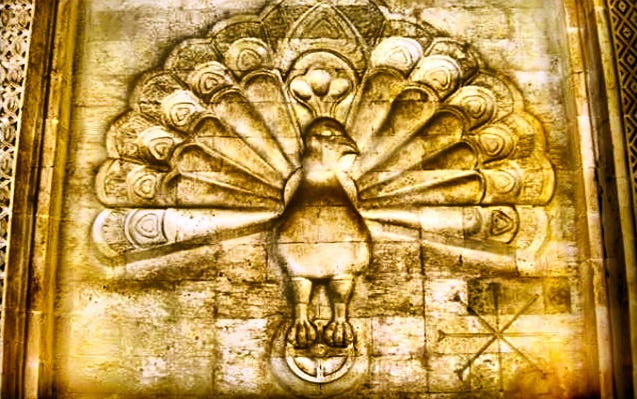
In Elif Shafak’s “There are Rivers in the Sky” the little girl Narin, overhearing a worker in a Turkish hospital, asks her grandmother why he called them “devil worshippers”. This is the first jarring moment in the book as you realise that what we are seeing is the genesis of genocide, of hatred. Later we read how the grandmother, growing up, had been friendly with a Muslim girl and how while that friend’s family were outwardly friendly, they refused hospitality to the extent of hiding a glass of lemonade behind a tree. Supping with the grandmother’s family was, for those Muslims, ‘haram’. Even to the point of refusing to drink water.
This is fiction. That’s what you tell yourself. Just fiction. The world isn’t really like that. Until you hit the real world and realise that this little girl and her grandmother are Yazidi. And that the genocide became real. Those people who considered that old woman and little girl to be “devil worshippers”, adherents to what we’ll call popular Islam, really did get infected by a violent passion. And that violent passion resulted in the genocide of the Yazidi.
“Approximately 400,000 Yazidis fled to the neighboring Kurdistan Region of Iraq and tens of thousands took refuge on Mount Sinjar, where they faced near starvation. The rest, unable to flee, were killed or taken into captivity and subjected to horrific acts of violence – enslavement, forced labor, conscription, torture, and rape.
ISIS considered Yazidis “infidels” and ordered men to either convert or die. Women, on the other hand, were given no choice. They were taken captive, married off to the highest bidder, sexually enslaved, and forced to convert.
More than 6,000 women and children were taken captive by ISIS and nearly 2,800 are still missing today. Sexual violence was strategically used as a weapon of war and codified in ISIS manuals that explained how to traffic Yazidi women. ISIS believed that violating women would destroy the community from within.”
People that ask about the origins of what we’re told to call “islamophobia” should perhaps pay attention to the Yazidi experience. But, as Shafak’s book makes plain, the experience of these people, their treatment by Christians and Muslims - especially Muslims - is one of exclusion, mistrust and hatred. Simply because they maintained, clung to, their ancient relationship with G-d and the world. “Convert or die” screamed the Muslims of Daesh, just as the Catholics of Spain and Portugal had done to their Muslim, gypsy and Jewish communities. And because abandoning a thousand and more years of faith, dumping your entire culture, isn’t a simple thing, these people stood in shock as their oppressors hacked, bludgeoned and shot them leaving piles of the dead as a memorial to hatred.
Genocide isn’t about killing lots of people, although that’s necessary to its execution. No, genocide is the culmination of years - decades, even hundreds of years - of disdain, distrust, lies and hatred. The Yazidi weren’t slaughtered because they weren’t Muslims. The slaughter was because, despite fifteen hundred years of Islamic proselytising, those Yazidi had retained their ancient faith. Like Catholicism in Elizabethan England it was an affront to the religious certainties of the people with the armies, the guns and the power. And these people were devil worshippers, possessed by demons, why would you not destroy them?
When you read about Mount Sinjar, even in a fictional account such as “There are Rivers in the Sky”, you can’t avoid the truth. Thousands of armed Muslim men slaughtered an innocent, unthreatening community simply because they refused to be Muslim. Worse, those Muslim men chose to kill the Yazidi men and enslave the women, or at least the younger, more sexually attractive women. Including, as Shafak’s book describes, girls as young as nine.
People criticise today’s Christianity as having lost its punch, its passion. Some level criticism at portly bishops piffling about peace, love and understanding and suggest that there’s a need for something sterner, an assertive Christianity. For sure, much of this 21st century muscular Christianity comes from people whose connection to actual church-going is tenuous but do they consider the reality of a reconquista? The reality is Mount Sinjar, the cruel destruction of communities simply because they cling to their faith.
Do Muslim communities in the West feel embattled like those Yazidi families in Iraq, Syria and Turkey? I don’t get a sense that this is the case or that there is any real threat to their lives. Yet we are told, in a search for victimhood, that the world is troubled by “islamophobia”. Reading about the Yazidi, however, it is easy to understand why, for some people - those Yazidi, Jews, Ahmadi, Parsee - fearing Islam isn’t an irrational thing but entirely justified. And the Islam to fear isn’t the intense, theological Islam of stern bearded Imams but the popular Islam of people who really do believe that Yazidi worship the devil and Jews take babies for their blood and harvest bodily organs.
It doesn’t start with bloodlust. It starts with a medical orderly muttering “devil worshipper” almost out of hearing. It starts with “what do they do in that temple on a Saturday?” And it continues with talk of magic or secret meetings, of sex and drugs. These lies sink into the popular understanding and, for adherents of a competing idea - religious or political, fester away becoming the hatred that drives firstly exclusion, then oppression and, if the evil ones are poorly armed or vastly outnumbered, finally genocide.
Muslims are not under threat in Britain. This isn’t to say that there’s no anti-Islam words, pictures or commentary. But this is nothing next to the Yazidi experience. To demand a special protection - “islamophobia” - in an almost entirely benign and supportive environment is an act of assertion, aggression even. Compared to those Yazidi, and to Jews across Europe and North Africa, the experience of Muslims in Britain is almost entirely positive. It isn’t that the majority population understood Islam but that they weren’t really bothered by it. We now live in a place where Muslim exceptionalism means we have to be bothered by it, to accept how it bends what we do or to kick back. And the calls for rule about “islamophobia” are designed to stop people kicking back. We do not need such rules.
There is only one community in Britain who live their lives within a security blanket. Behind gates manned by suspicious men in stab jackets. Whose schools are prickled with security and who are asked every day to justify the actions of others. A minority, a tiny minority, just 300,000 in a population of seventy million. This community isn’t a Muslim community, it isn’t a violent community, it is - or has been - integrated into wider society, but like that Yazidi community in Iraq it lives within an ancient, truly ancient faith. This community is Jewish. And to draw a parallel between their world and the lives of British muslims is wrong.
There are over two million British muslims. They are noisy, filled with pride and increasingly successful. This community doesn’t live behind a screen of security, is indulged by every vote seeking politician and by virtue signalling bishops, and enjoys an almost entirely uncritical media. We should remember that it was popular Islam, the Islam of the Muslim streets, that set about eliminating the Yazidi for the only crime of not being a Muslim in a place where violent men thought everyone should be a Muslim.