

Eliot Wilson writes about Sir Thomas Gresham (him of the law about bad money driving out good) who among many other things founded the Royal Exchange in London. Gresham, Eliot explains, stole the idea from the bourse in Antwerp meaning that, in our mind, the Royal Exchange becomes a sort of proto-stock market rather than its reality which was it looking more like a municipal market hall. Although Gresham borrowed from the continent by making his hall open to the public, the origins of the trading hall go back a lot further in England and he would undoubtedly have known of and maybe even visited selds.
Annie Gray, in her history of the high street, describes the seld:
“The name was sometimes used to describe long, narrow lines of market stalls, but quickly came to mean a permanent hall containing tens of small booths, each leased to a different trader.”
From the 13th century to the 17th century these selds, the word comes from Latin rather than a Germanic root, provided specialised shopping and a place where merchants in the same business could meet and do that thing Adam Smith criticised. These meeting places for merchants (most notably Westminster Hall where stalls sold ink, pens, parchment and clothing to lawyers attending court) weren’t sombre or staid - we’d say ‘businesslike’ these days - but bustling places of exchange. Most selds would, as well as the goods being traded, feature a tavern and often a brothel providing food, drink and comfort for the visiting trader. The Royal Exchange, for all its grandeur was little different and provided both a meeting place for merchants (and most conveniently, like London’s clubs in a later age, an address where a merchant could receive mail) and a fashionable shopping mall.
London had several exchanges (such as New Exchange and Exeter Exchange) each copying Gresham’s model but less successfully since they lacked the bourse function as well as the Royal branding that Queen Elizabeth had granted to Gresham’s outlet. What was notable in all of this, as had been the case with the selds, was that business, shopping, leisure and pleasure were mixed in the same places. Often literally under the same roof.
Critical to the success of these exchanges was that they set and sustained a set of rules that didn’t apply to street trading. It was in the interests of the exchange’s management to get high standards of cleanliness, behaviour and quality of goods. Even back in Tudor times a large proportion of street traders, perhaps as much as half of them, were women and this is reflected in the Royal Exchange where 40-50 of the 150 or so stalls were run by women. Trading in an exchange, or later a municipal market hall, provided safety and security, the value of the market or exchange’s brand and a guaranteed footfall of paying customers.
Street markets remained the principal place for daily shopping, even in London where they were essentially illegal. If you ever wonder why fruit and veg is sold from a barrow and fish from a basket, it is because peddlers were allowed to trade. Peddlers had to be mobile (they still are and you’ll see them still today mostly selling cheap toys, mobile phone covers or cleaning goods) and so traders turned to wheelbarrows and baskets. In the latter case - flower vendors and bakers did this a lot - the basket couldn’t be set on the ground so the seller balanced the basket on her feet. The City of London was very keen on enforcing its market charter which means that the main street markets were just across the border of the city - Petticoat Lane, Colombia flower market and markets at Shoreditch and Whitechapel.
Elsewhere in the country markets were an established feature of every place - that’s where we get the description ‘market town’. Street markets in England were general markets rather than specialised, except where the town itself was noted for particular products. Elsewhere in Europe many street markets were specialised. Umbertide in Central Italy has a weekly market of shoe sellers and Florence’s New Market is famous for leather goods. In England, however, the big street markets in places like Skipton and Walthamstow sell a general range of goods - food and drink, rags, swag and fancy goods.
But street markets were untidy, hard to police and many towns opted to move the market indoors to a purpose built hall. Once you’ve got a hall and traders, it is a logical step for the market to stop being once or twice weekly and to open, like the grand exchanges in London and the high street, six days a week. Municipal markets had rules like those exchanges and the market authorities could police the activities of traders from the relative comfort of the market floor rather than chasing a lad with a barrow (who turns out to have a peddlers licence).
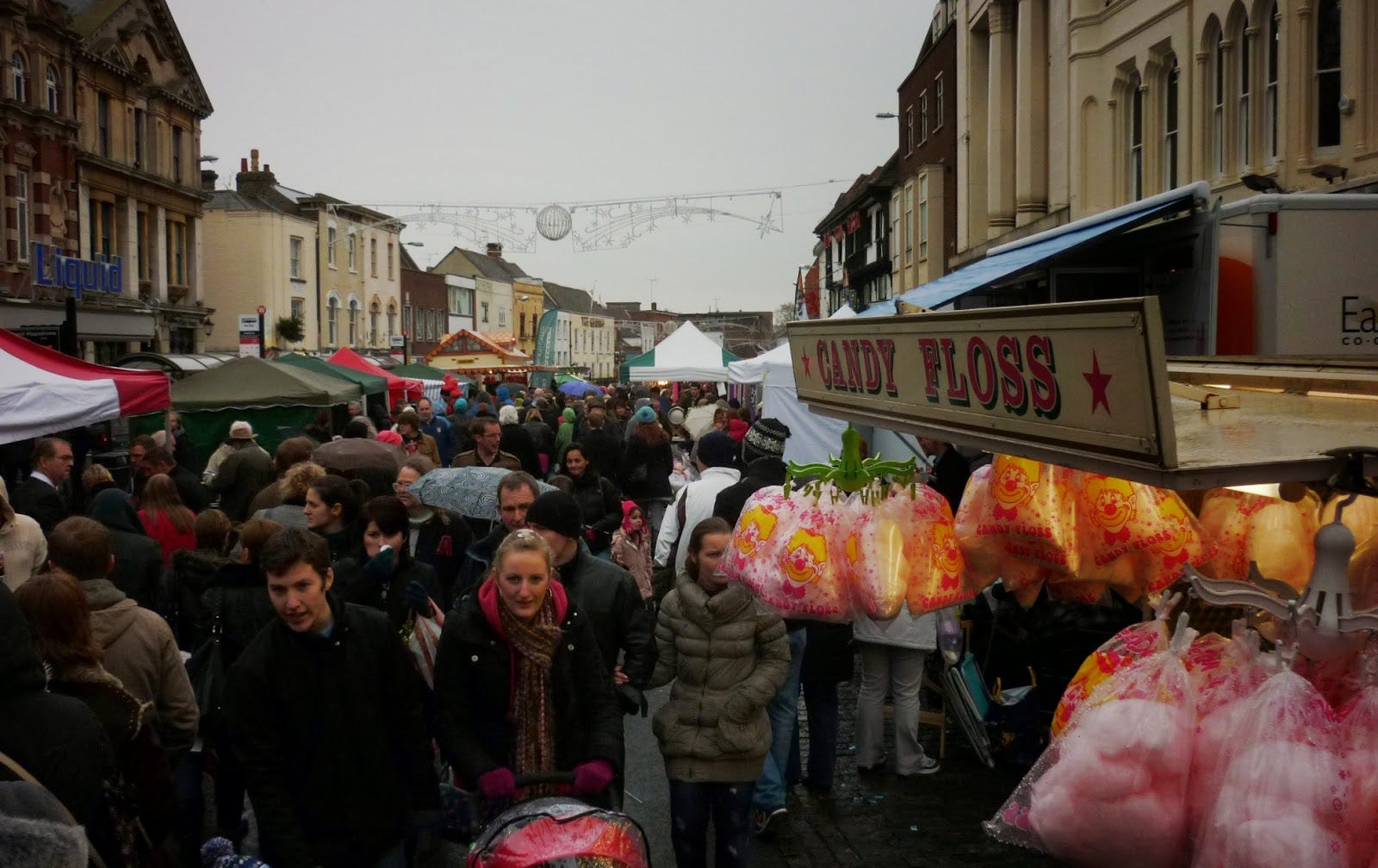
We tend to assume that shopping always took place on the high street, at least until first the supermarket then the big box pushed people out of town. But the city high street of department stores, grand toy shops and lots of shoe shops only really began in the late 19th century and, today, this kind of comparison shopping is becoming a thing of the past. Where high streets still thrive the dominant use is now a variety of places to eat and drink or specialist shops, delicatessens and gift retailers. The act of shopping, like Hoagy Carmichael’s ‘Little old Lady’, is still a pleasure for many but the old high street often doesn’t fit people’s needs or expectations any more. Instead we have craft fairs, Christmas markets, and food festivals. People wander round farmers’ markets, flock to look at antiques in drafty old barns, and shuffle round crowded tents at agricultural shows. There’s no lack of interesting and unusual retail but not much of it is on the high street, people will instead drive for miles to designer outlets, buy tickets for arts fairs and tramp through the mud at a boot sale.
When Sir Thomas Gresham set up his exchange, he took the expectations of everyday shoppers and placed them in a glorious central London setting. Gresham saw that swank and style would pull in customers and, even better, that making his exchange a place of business too wouldn’t just provide a service to merchants but his stalls selling lace or buttons or boots would bring in those wealthy merchants’ wives and their friends. The lessons from retail history are that you can’t make something, let alone a high street, successful by government action. Shopping is a private matter and success in retailing comes from meeting the needs and wants of private buyers. And most of the time these days our high streets simply don’t.
In India I was fascinated to drive through whole towns which specialised in making one type of product. It could be stone carvings, wooden doors, flower pots or whatever, while streets dedicated to the manufacture of one product and many different price levels. I assumed it was an Indian thing but reading your excellent article I discover it’s as much a European thing as Indian. As a Brit I wouldn’t know this of course, being used to abundance and variety at every turn! I jest but it’s interesting to bite that the biggest market in Europe in medieval times was not on continental Europe but on St Giles Hill in Winchester, sadly no longer a market place but no less important because of it.
Two things make a shopping space work (whether a high street, a market or out of town location) 1. access (of which parking is a big part) and 2. places to sell from that are affordable for the traders to sell from.
High streets die because parking and access is getting worse and more expensive, so people drive to out of town malls with huge free car parks, or big box stores or garden canters, all with lots of free parking. They also die because the rent and rates are too damn high. So they stop trading, or trade from home online, at a unit in an industrial estate or at the mobile fairs and markets, or some combination.
Wakefield just about has a functions town centre, but sections of it are at an advanced stage of decay. But trading is happening accross the area, in units in industrial estates, under railway arches. With good parking provision and lower running costs, these business could move to an actual shop and bring some life back to town and gain some footfall. We even have a pub in an industrial unit when there are empty pubs in town. It’s madness.