

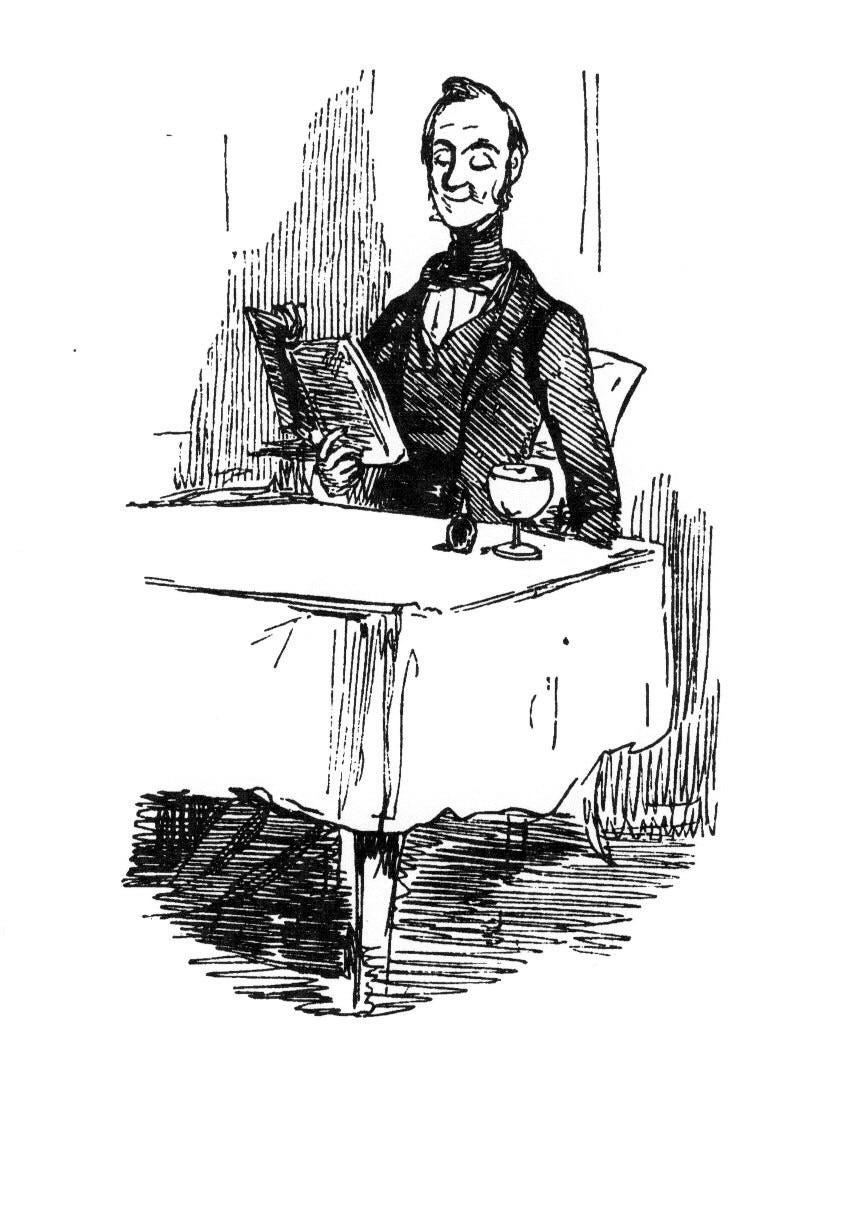
“About the British Snob, on the contrary, there is commonly no noise, no bluster, but the calmness of profound conviction. We are better than all the world; we don’t question the opinion at all; it’s an axiom.” William Thackeray from The Book of Snobs
This week’s Spectator Diary written by the magazine’s owner, Paul Marshall, reminded me of my late father-in-law with this little anecdote:
“Forget Macron or Lecornu, or even Bernard Arnault. The most powerful man in Paris is Luc, the maître d’hôtel at Brasserie Lipp. If you look like a tourist or, most heretical of all, come dressed in shorts, you will be dispatched upstairs. If you are not known to Luc or his team but look respectable, you may qualify for a seat at the back of the restaurant. If you are a regular or a friend, you can hope for one of the prime tables in the front. From there we watch through the mirrors the comings and goings of Parisian intellectual life…”
My father-in-law was a great one for telling us how the maître d’ at this or that restaurant or hotel knew him. This, of course, came with the hint that this being known comes with privileges, special treatment and advantage. Just as Paul Marshall does in his anecdote, we’re reminded that they are special, more important, grander people because the maître d’ knows their name. Now there’s no doubt that, Paul Marshall being a very rich man, the restaurant has a great interest in treating him well (one hopes they treat everyone well but the anecdote suggests otherwise) on purely economic terms.
The thing here isn’t, however, the fact that Paul Marshall gets looked after well at a restaurant he has visited often but that he feels it necessary to tell the world how important he is and how us mere mortals would be ushered away into the furthest recesses of the establishment because we “look like a tourist”. The very epitome of Thackeray’s British Snob.
All this brings to mind a wealthy publisher with whom my wife had business dealings (I think she bought some journal titles from him). This gentleman, the owner of a gorgeous Ferrari Spider, was in London and passed by a car dealership in which he saw a special edition BMW. The gentleman was, at the time, wearing scruffy work clothes because he had been clearing out some rubbish at his mother’s flat. Our publisher pops into the dealer to look at the car and, to put it mildly, is treated rather rudely. Later that week he bought the same car from another dealer and drove to the snobby London dealer to point out to them that they could have had the commission if they’d not been so rude.
It is quite hard to get to grips with the idea of snobbery because we were inured to different characterisations of the tendency: Oscar Wilde’s Lady Bracknell, the excruciating Hyacinth Bucket, and endless dramas featuring social class each one disparaging the social climber, the nouveaux riche or hoity-toity middle class manners. Elsewhere there’s a sense, so well satirised by Thackery, that snobs are necessary as arbiters of taste, cultural mavens that can guide us through the right and wrong of decor, clothing, speech and food. Plus music - here’s Charles Moore sniffing about Radio 3 Unwind, the BBC’s attempt to rescue some audience from Classic FM and Spotify, and the channel’s further endeavours to build an audience:
“Radio 3 Unwind is the broadcast equivalent of assisted dying, music as a drug to end life’s pain. Music can indeed be balm to the troubled soul, but a whole channel devoted to this degrades culture into therapy. Turning on Radio 3 proper in the car this week, I heard Georgia Mann excitedly announcing the first ever weekly classical chart, whose hit parade the station will avidly report. So Radio 3’s classical music offering is now a choice between a 33rpm version of Top of the Pops, and the sleep of death.”
Simply putting on music in the background (and if Charles Moore was driving the music is quite literally background to his primary activity of watching the road, my old boss Barry North refused to allow music in the car because it distracted from safe driving, indeed you couldn’t even talk to him when he was at the wheel) is not the monstrous insult to the music that people like Mooore and Simon Heffer, in acts of glorious snobbery, would have us believe:
“Even more depressing is that I am told many people do actually listen to it, a comment on some of our fellow Britons that I would prefer not to dwell upon. Others of us have grown up believing the canon of classical music contains innumerable works of art that should be approached and treated as such, not used as incidental decoration. The Classic FM/Unwind model appears to focus upon music the former has long categorised as “smooth”: music that will not interfere with any doze you might choose to have on your sofa or in your armchair while you listen to it. Concealed from the poor devils who fall for this garbage is the fact that much of the world’s greatest music is disturbing, turbulent, violent and noisy and, as a consequence, opens up psychological depths beyond those attainable through repeated indulgence in Chanson de Matin or the theme tune from Band of Brothers.”
If Moore and Heffer were simply to rant about how classical music channels play altogether too much Vaughan Williams and not nearly enough oratorio, I might be cheering them along (out of personal prejudice) but they aren’t doing this, they are telling us, like Paul Marshall at his Paris restaurant, they they are better than us and that institutions like grand Paris hotels and the BBC should indulge their greater knowledge not the preferences of a larger, ignorant audience.
Unsurprisingly Country Life is keen to jump to the defence of snobs, mostly by redefining what the word means and by quoting overrated critics like Anthony Bourdoin (“I don’t want to sound like a snob; I am a snob, but I don’t want to sound like one”). We’re told snobbishness is great but not when it’s about accent, water bottles or dessert:
“But is it a good thing that we are no longer snooty about art? About food? About taste? More than an existential question for the snobs themselves, it presents a conundrum for society. For who will keep us on the straight and narrow if we don’t have a designated authority to do so?”
Somewhere out there designated by who knows what, there is someone who’ll tell you your outfit is trashy, that no intelligent person finds Michael McIntyre funny, and that those mid-market bar restaurants with vaguely Italian sounding names are irredeemably naff, especially if you drink prosecco in them. Above all modern snobbery manifests itself through a set of active social, even regulatory, controls. Eating McDonalds isn’t merely naff, it is bad for you. It is largely OK to smoke cannabis, despite it being literally illegal, but inhaling essentially harmless blueberry vape is utterly beyond the pale. If you take a step back from the endless moral panic of public health the unmentioned truth is that it is all about snobberry not health. The bad things - ultraprocessed food, vaping, betting shops, lager and fizzy pop - aren’t bad things because they’re worse than the snobs’ choices, they are bad things because they are done by those who, in my father-in-law’s words, ‘aren’t our sort of people’. These bad things fall into the same category as garden Christmas lights, hen parties in Benidorm, and demi-sec blush wine. Oh, did I mention Mrs Brown’s Boys!
The objective of the snob is not to elevate others but rather to validate their own preferences by presenting them as superior. And the arena where the snob is most powerful is the arena of, in its wider sense, culture:
“By possessions, I mean increasingly cultural and social capital rather than simply economic capital. Indeed ,the simple display of material possessions could readily become the object of snobbery. In these matters, at least, cultural capital trumps economic capital. Further, for our present concerns, what is important is the way in which cultural capital interacts with social capital.”
This is from the late David Morgan’s brief essay on why snobbery matters. I think that it captures the most important aspect of the snob; not the social climbing of Mrs Bucket but rather the conscious endeavour to characterise the culture of another group as inferior, to dismiss their mores, their lack of the right education (‘what! You haven’t read Iffy Haughtynose’s Booker Prize shortlisted social commentary?), and their musical, art and food choices. Above all the snob is not trying to bring you gently into a better word but rather, as we saw with Paul Marshall, telling you that, because you dress or speak wrongly, you can’t be part of my superior world.
I have a (now sadly dead) friend who, if you said he came from Cullingworth, would stop you and say “well… Hallas Bridge”.
Here in California, if you have lived in a mountain community for some time, when the weather gets cold and you're still wearing a simple cotton hoodie sweatshirt, you've likely been a resident for years and are looked on as such. Wear a modern down puffer jacket, well know we know you're from the City.