

“The Hubris of the Verdant Throne: Sessions for the Island of the Thorned Crown”
This is the headline produced by AI - Grok in this instance - for a Dungeons & Dragons game I run every Wednesday. I’ve been experimenting with using AI to help, speed up, the process of preparing sessions for D&D (and for another group, the SF TTRPG, Traveller). I came to this with a blank page since I haven’t used AI for anything else and didn’t read about others’ experiences using freely available AI systems to support the preparation of sessions for table top role playing games (TTRPGs). I did see a comment from Brennan Lee Mulligan - currently DMing Critical Role’s latest iteration - that if he wants someone to get the rules wrong he doesn’t need AI, he can just ask his players. This does chime with my experience.
The journey starts with a group I play with on Mondays. We’d finished a campaign and were talking about what next. The talk turned to how much information an experienced GM would need to run a session or even a short campaign. Paul then jokes: “sexy goblin tuxedo, that’s enough surely!”. Since Paul was sitting next to his PC, he opened ChatGPT and asked “create a five room dungeon on the theme of ‘sexy goblin tuxedo’”. We played this dungeon (using Paul’s own TTRPG Weirdspace rather than D&D) and it seemed to work even given the limitations of the prompt Paul used. I’ve a feeling here that, since Weirdspace is a sandbox, anything goes, sort of system and its creator was running the game, the limitations that Brennan Lee Mulligan observed were avoided.
My first attempt at using Grok to produce a session was for an online game and, while the resulting content was interesting, there were too many errors and disjunctions to use it unchanged. I’d endeavoured to populate a maze in a Minotaur city (where else would you find a maze) with traps, tricks and monsters. Grok did this enthusiastically but was very weak on the specific mechanics of traps and the capabilities of monsters. It was necessary to either ask Grok to elaborate on its trap or else to write the mechanism myself. In the end I extracted the stuff I liked from the AI-generated content, found a good maze battlemap, and (with the assistance of my six-year old granddaughter) populated the dungeon ahead of inflicting it on her father. The AI saves some time and, if you’re not good at traps, tricks or riddles, can provide these for you quite effectively.
The next experiment with AI was in creating a whole campaign. I’d chosen to use Amy Jeffs wonderful reworking of Saxon poetry, Wild, as the basis for the campaign. Specifically it was the story Jeffs wove round one poem, The Seafarer:
“Let me sing the song of my truth
Speak of the journey - how I often endured
Backbreaking days and deep desperation,
Sat with sharp sorrow at my chest…”
To provide further context, I referenced Ursula Le Guin’s “Earthsea” in the prompt given to Grok. This fitted the seafaring theme since Sparrowhawk, the wizard of Earthsea, is a seafarer, travelling from island to island in a magical boat. I added some further information about the sort of campaign (exploration, magic-focused, mythic) and pressed the button. The resulting campaign outline starts like this:
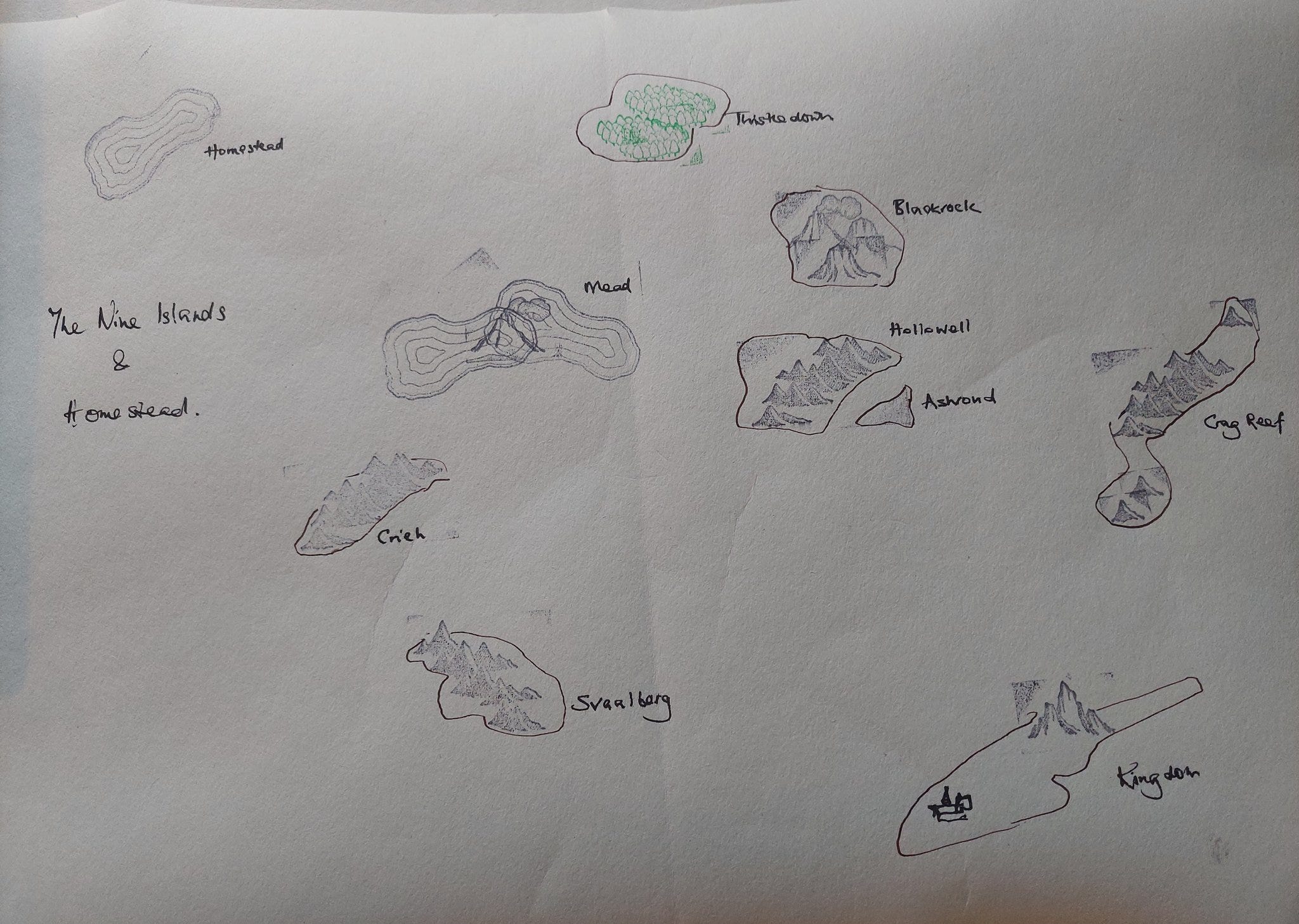
“This campaign draws from Amy Jeffs’ Wild, particularly the chapter “The Message in the Sand,” and her translation of “The Seafarer” from The Exeter Book. It emphasizes the haunting, elemental mysticism of Anglo-Saxon poetry and Jeffs’ evocative storytelling, blended with the magic-heavy, mythic tone of Ursula K. Le Guin’s Earthsea. The campaign focuses on exploration, isolation, and the interplay of fate and free will across nine perilous islands, each with a unique mystic threat.”
To borrow from Douglas Adams, it does calm down a bit after this slightly gushing opening and, while the flowery language remains, the campaign outline concludes with:
“The PCs explore the nine islands in any order, gathering Song fragments. Each island’s peril ties to a theme from “The Seafarer” (e.g., exile, fate, divine mystery) or Wild’s mythic imagery. The campaign concludes when the PCs collect enough fragments to confront the Song’s guardian—or choose to shatter it forever. The ending remains open, shaped by PC choices (e.g., restore balance, seize godlike power, or abandon the quest).”
As the basis for a campaign this is pretty good. Grok also provided outlines for the nine islands (Island of the Wailing Stone, Island of the Burning Tide, and so forth) which was helpful. The detail was less useful and Grok seemed to assume the players were really good at role playing characters from the start rather than the reality of us all being bumbling amateurs. It still left me with plenty to do, using AI did help (and my prompts could probably be improved) but the task of getting the game balanced, rules compliant and playable fell to me as DM.
Which brings me to the headline I opened with: this was an attempt to use Grok (linking to the earlier campaign outline) to produce 2-3 hour sessions for one of the islands. The language remains a little overblown (“Aeloria now rules as a verdant despot, her form a cascade of blooming thorns and silken vines…”) but, as with the campaign overview, the AI produced a usable session structure, direction and purpose. Because my prompt had included timings, Grok suggests how long each section of the session might take which I found quite helpful. My issue with the content, however, was that it needed extensive reframing to fit player expectations, style and experience. Plus the expectation that those players will ask to make the skill check necessary to make the session function (spoiler: they didn’t).
I will continue to use Grok to help develop the story by feeding in the evolution of the player characters and the changes I’ve made (the song shards are individual chimes, for example) but each creation using AI needs to be carefully checked and, as I’ve found playing, a lot of good content is invented on the hoof. One island ended up with an entire sub-plot about the innkeeper’s daughters and I’ve introduced encounters between islands, some of them plot-relevent but others just a hungry sea creature.
I still prefer to write - usually with an ink pen in a nice notebook - my own storylines. In one campaign I run (the one with the maze mentioned above) the story is quite complicated now with multiple loose ends that need threading back into the plot as well as differing backstories for the player characters. The physical process of writing helps keep track of the plot (more or less) and, where I use AI it is to provide a specific description of something or someone. What works well is using Grok as a sounding board, prompting an idea of mine to see what it develops.
I’m a reasonably experienced DM and can improvise in-game, Grok (other AI are available, I tried Gemini but it was less good than Grok for my purpose) can enhance the game creation process, reduce preparation time, and help make riddles or puzzles which I find difficult. For a less experienced game master, using AI for anything other than a broad outline of a campaign or session would probably not make the gaming easier. I find Grok useful for fleshing out NPCs - what they look like, names, outlook and attitude - which avoids the problem of a barman you randomly called ‘Dave’ thinking that the players would simply buy a drink and move on but whose story (which you also made up on the spot) is now central to what the players want to do. What I also like, partly because it is the sort of scene I like to run, is that Grok puts in environmental dangers as well as monsters - sliding rocks, poisonous plants, biting insects and tangled thorns are often enough to occupy player characters for an hour!
So next week the players will enter the Thornmaze searching for Aeloria, the corrupted dryad. But only after they’ve dealt with the strange elven ghosts fighting an ancient war. The elven ghosts I made up this week because we had half an hour left of the session. Right now I don’t know what will happen with these ghosts but it will be fun!