

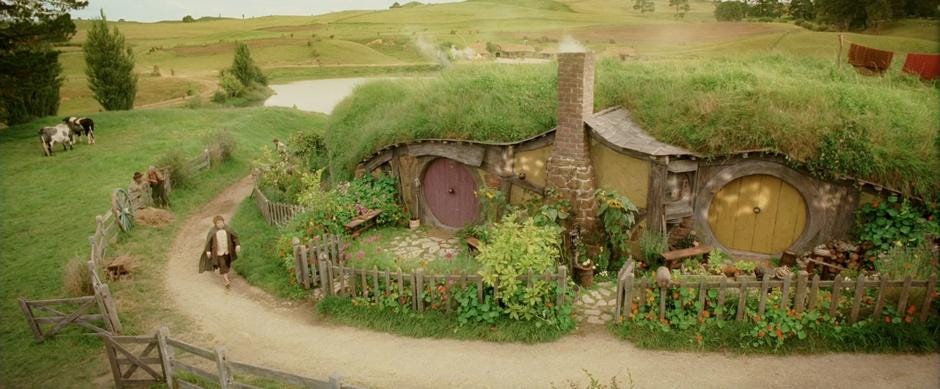
The Lord of the Rings is the most important, most consequential, novel of the twentieth century. You don’t have to like Tolkien’s masterpiece or even believe it to be well written to acknowledge that its significance and impact on literature and our wider culture is enormous. Beginning in 2001 a monumental film version, directed by Peter Jackson, was released. Many, I’m not especially qualified to assess, consider the film trilogy and especially 2003’s “Return of the King” also to be a masterpiece. And, while I loved the films, I’m not alone in seeing that they changed the emphasis of the story losing the sense of corruption that followed the ring and Sauron (an idea of original sin that was perhaps too Catholic for modern tastes) as well as cutting out the ‘Scouring of the Shire’ and the final confrontation with Saruman - Sharkey - back where the story began outside Bag End.
I’m writing this because I want to write about The Odyssey, or at least some of the critical responses to Christopher Nolan’s epic adaptation of Homer’s poem. Not the “it’s too woke” criticism because a black woman was cast as Helen of Troy or even that a transman plays a boy soldier called Sinon (who, of course, doesn’t feature in the poem). Watching the film, neither of these supposedly ‘woke’ attacks on Western civilisation seem incongruous or without purpose.
Nor am I concerned with those obsessed with what might be called “kit purity”: iron swords in the Bronze Age, the wrong sort of armour and inauthentic ships. I’d be happy to read about the arms and armour of Bronze Age Greece (probably more leather and spear than sword and breastplate) but, just as the modern obsessions about woke don’t matter to a story neither does a quest for archaeological accuracy.
What annoys me is the manner in which some experts and a whole load of what can only be called ‘Homer Nerds’ attacked the film (sometimes without seeing it) because it did not cleave purely to Homer’s narrative but uses the thread of Odysseus’s story to create a modern narrative about the collapse of civilisation, guilt and homecoming. There are a mixture of criticisms most notably from from Emily Wilson, whose 2017 translation of Homer’s poem Nolan cites as an inspiration for the script. In Wilson’s review it is clear she doesn’t like the film mostly because it sails too close to superhero movies or even, god forbid, “..is often reminiscent of other 21st-century screen ‘epics’, not least Peter Jackson’s Lord of the Rings trilogy.”
It feels like Wilson (who in classic left wing LRB style steps out from the review with an ethical snipe at the film locations in the Western Sahara) wants a film version of an imagined National Theatre production targeted not at the movie mass market but at a bunch of luvvies who want Homeric purity (plus more sex) rather than a gripping narrative. Wilson’s conclusion (other than a slightly self-important bit about how the film might encourage people to read the poem and stop universities shutting down classics departments) captures this idealised version:
“It lacks psychological, emotional, political and ethical depth. Its narrative structure is gimmicky. The writing is abysmal. None of the characters has convincing motivation for their actions or words. There are no sex scenes, and all the food looks horrible.”
This concern with narrative purity is repeated across the media and, aside from people with flags and symbols in their nametag on social media shouting about the end of western civilisation, makes for a huge difference to the way in which Lord of the Rings Nerds reacted to Peter Jackson’s film adaptation:
“Huge contrast between the prissy-ness of classicists about The Odyssey and the “wow this is great but...” response of Tolkien nerds to the LotR trilogy.”
I shared this comment on ex-twitter because the difference strikes me as interesting. Tolkien fans set off to watch the films excited and hopeful, returning having been entertained royally by a magnificent spectacle - why shouldn’t adapting a Greek story of derring-do, The Odyssey not be equally magnificent?
Tolkien fans, the ones who have read the book ten times, poured over the appendices, consumed books about the man himself and, these days, chatted on forums or listened to podcasts exploring the books and the film. All of us see the film’s flaws - the rewriting of Aragorn, the exclusion of Bombadil, the elevation of Arwen to provide romance earlier in the story, the sidelining of Faramir and the dechristianising of the story. But all of us, with no exception I’ve found, will tell you that the films are great (even the odd bit with Legolas surfing down an elephant’s trunk).
I’ve never read The Odyssey, relying instead on partially remembered lessons from school and children’s storybook adaptations that focus more on the monsters and magic than on the narrative of xenia, homecoming and Penelope’s suitors. I wanted the experts, even the self-appointed experts who read the poem once a decade ago, to show a bit more enthusiasm for the effort made to bring a dense and nuanced story, from a time of a different ethos, to a modern film audience. That audience is, remember, steeped in superhero movies (if Odysseus isn’t a superb hero where have I been all my life) and high fantasy. The carefully balanced, true to the poetry, version of the story that the purists want would, without question, have flopped just as would a Lord of the Rings adaptation with twenty minutes of Hobbits eating Bombadil’s dinner.
And, it seems, Nolan has made a film that is genuinely popular:
“Yet Nolan’s reputation appears to override conventional headwind. The director’s ability to turn dense, adult-skewing material into must-see theatrical events remains peerless. The Odyssey now claims the second-largest second weekend ever for an R-rated picture, trailing only Deadpool & Wolverine, which collected over $96 million after a record-shattering $221 million domestic debut.
After all, domestic receipts stand at $286 million, while international markets have contributed $353.2 million, pushing the global tally to $639.6 million after just 10 days, according to Box Office Mojo. These numbers already place The Odyssey among the year’s highest earners, with plenty of runway ahead.”
The Odyssey is a good film. In many ways, quite literally, a spectacular film. The manner in which the soundtrack invokes the power of the goods and merges into the sound effects of storm and battle is fantastic. But, just as a purist adaptation of the Lord of the Rings would have worked less well than the epic fantasy version Peter Jackson produced, Christopher Nolan has brought the narrative of Odysseus’s homecoming into a style and ethical context that works for an audience used to Thanos, Spiderman and Game of Thrones. In Emily Wilson’s review there’s a snide remark (I suspect Wilson isn’t a Lord of the Rings fan) that sums up why the film works:
“At the end of the film, a character sets out to ‘sail beyond the sunset’ and I almost expected everyone to break into Elvish.”
The Odyssey, like the Lord of the Rings trilogy, succeeds because it takes the ancient narrative and twists it to suit a modern cinema audience. And it works because of these changes, not to have done so would have lost the ‘flawed superhero’ that is the central trope in most popular blockbuster films. Just as Jackson made Aragorn the hero of the Lord of the Rings rather than Frodo and Sam, Nolan has made Odysseus a troubled superhero like Spiderman or Batman because he knows that this is what the audience wants. A purist Odysseus filled with pride, celebrating the rape and pillage of Troy would have seemed incongruous to a modern audience.
As I concluded in another ex-twitter post:
“But because I’m one of the 99% of people who haven’t read The Odyssey but have half remembered school boy stories, authenticity is less important than fun. Maybe the way to respond is to enjoy the film and signpost the poem”
IMO it’s not unreasonable to consider Nolan’s inversions as more egregious than the subtler adaptations of Jackson (we are wholly denied the charismatic & wily teller of tales for a dour emotionally distant ptsd case). FWIW I went with it but was profoundly disappointed by the ending, not the retreat into the sunset (at least redolent of that Skyfall poem) but the role of Telemachus in the slaughter of the suitors. He’s pushed upstairs so as not be stained by bloodshed, but I wanted him proving his worth by fighting shoulder to shoulder with the old man. And I should’ve liked to have seen Laertes and the confrontation in book 24.
This is a truncated bit of Stelios Panegiotou's excellent comments on X about Nolan's Odyssey.
"Nolan’s movie depicted an ultra-disenchanted world.
..
This is part and parcel of an attempt to present the universe as roughly speaking amoral. It is the logical conclusion of reductive materialism: the dominant intellectual worldview in the west that presents value and morality as illusions and humans as meat machines."
https://x.com/Panagiotou90St/status/2079503202462863777?s=20
I think this goes to the heart of it.
LOTR, by contrast, retains the enchantment.