

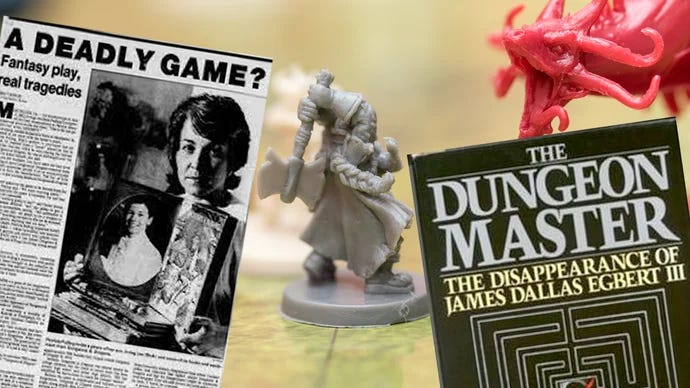
In June 1982 a teenager from Richmond, Virginia called Irving “Bink” Pulling killed himself with his mother’s revolver. Another tragic death except that Pulling’s mother Patricia believed that the reason behind her son’s suicide was the role-playing game ‘Dungeons & Dragons’. Specifically Patricia Pulling said that a curse placed, in game, on Bink’s character was the reason for him shooting himself in the chest that day. Pulling sued her son’s school principal and TSR Ltd, the creators of ‘Dungeons & Dragons’. The lawsuits were dismissed but Pulling remained convinced that the role-playing game was damaging to young people and, to promote this argument, set up B.A.D.D. - “Bothered About Dungeons & Dragons” - to campaign for controls over the game.
Pulling and a collection of enthusiastic Christians including Tipper Gore, wife of Al Gore and author of “Raising PG Kids In An X-Rated World”, created something of a moral panic about Dungeons & Dragons with Gore and Pulling appearing on national TV to argue that the game promoted violence, satanism and suicide. Some of the material produced seems bonkers 40 years later but was taken seriously by public authorities, at least for a while. The Escapist, a gamer website, has catalogued much of this panic (there’s a link from this excellent Gizmodo article on the scare):
“Here, a list of suicides are presented, with location, race, sex, and date of death for each. These are the names that were usually the first ones trotted out when the ‘dangers’ of D&D were discussed. Along with them, we get some supplemental data – all were white males between the ages of 12 and 18, three were honor or gifted students, all deaths but one involved a weapon, and – the most curious coincidence of all – half of these deaths occurred on a full moon.”
If we peer a little further back into the history of Dungeons & Dragons we find, from when the game was still wet behind its ears, the case of James Dallas Egbert III:
“Throughout the 1980s, the United States was gripped with what’s been referred to as the “Satanic Panic,” a surge of anxiety that blended such disparate items as reports of cult activity and ritual abuse, Halloween candy tampering, heavy metal music, horror films and novels, and role-playing games. One of the ignition points for this phenomenon occurred in 1979 when a young college student named James Dallas Egbert III disappeared. While the reasons for Egbert’s disappearance would become clear later, some observers and media personalities knew exactly what to blame: Dungeons & Dragons.”
We know now that the game had nothing to do with the suicides of Pulling or Egbert (indeed the private investigator in the latter case deliberately withheld information about drug abuse and struggles with sexual identity) but this didn’t prevent influential public figures from demonising D&D, resulting in fear, confusion and purposeless attempts to ban the game. It is this process, the making of moral panics, that leads again and again to adults seeing as bad the odd, occult, geeky and nerdy (or strange and unhealthy to the moral panickers) interests of teenagers. A panic made worse when something terrible and tragic - suicide, murder, madness - occurs.
I don’t know how many people were playing D&D back in the 1970s and 1980s, a few million worldwide at most. Some took it more seriously than others but for most of us it was a slightly geeky game that wasn’t like other games: more immersive, not a win or lose game, creative and original. I guess, however, that most people thought us mad. Today, we are watching another moral panic play out filled with the same tragic stories of death, self-harm and madness. A panic about teenagers and something they do that we sort of understand (Dungeons & Dragons is a game, we understand games, yes?) That panic gives rise to these beliefs:
“Their effects appear to include contributing to declining mental health, collapsing attention spans, bullying and general unhappiness, as well as contributing to broader crises such as falls in literacy, loneliness, fertility collapse and political polarisation. In some cases this is due to direct harms caused by use; in others, it is because the addictive nature crowds out other, healthier activities such as outdoor play or in-person socialising with others.”
These are familiar words to those who recall past moral panics - the Dungeons & Dragons example I describe above but also computer games, song lyrics, films and TV shows. Those who paid attention during the 1970s will remember Mary Whitehouse (for Americans reading she was an English 1970s version of Tipper Gore) and her ‘Viewers and Listeners Association’. And historians will point to 18th century worries about how that terrible new thing, the novel, was corrupting young women, stopping them doing “...healthier activities such as outdoor play or in-person socialising with others.”
The quotation above comes from an article entitled “Social Media Ban: Responses to 10 common objections” which is, once it calms down, a very clear presentation of the case for a ban. The problem, and it is a real one, is that the context for the argument is, quite simply, that the content and availability of media is harming young people. It is exactly the same argument as we read here in a 1974 Spectator article:
“(it) may teach self-interest rather than philanthropy, violence rather than gentleness, a disregard for human dignity rather than a respect for it. It may not always teach the truth but teach it does, and it is more than time that responsible people both within and outside the broadcasting professions said boldly what is so obvious in commonsense terms — we cannot understand what is happening in international, cultural, economic, political and social affairs without coming to grips with the way in which television influences virtually all our behavioural and thought processes.”
Just as there was no evidence linking TV to teenage mental health, no evidence connecting Dungeons & Dragons to suicide, and no evidence showing violent video games spawned more violence, there isn’t evidence connecting social media use to the traumas of modern adolescence. Here’s a meta-analysis from 2025:
“This was investigated in a meta-analysis of 46 studies of youth social media use and mental health. Results indicated that the current pool of research is unable to support claims of harmful effects for social media use on youth internalizing disorders. Some types of methodological weaknesses, such as evident demand characteristics and lack of preregistration, remain common in this area. It is recommended that caution is issued when attributing mental health harm to social media use as the current evidence cannot support this.”
That’s about as blunt as social science research gets yet here we are using anecdote and parental worry to argue for a ban that is wholly unsupported by evidence. All because of these same tired old fears about novel media and its impact on children (and indeed adults). There is an argument for looking at the impact of the smartphone on our lives but that’s a case for setting the terms - as we did with TV (and before that radio and books) - for wider culture to catch up with technology. Bans don’t do this. Bans tell us something is bad. Worse bans don’t work (unless you think putting 30-40% of young people at greater risk is some sort of harm reduction).
I appreciate that I’m shouting at the oncoming storm here by opposing a social media ban for teenagers. But we are about to take away a load of social fun and entertainment from teenagers for the very same reason that Patricia Pulling and B.A.D.D. tried to stop my generation from rolling dice to see if we’ve killed the goblin. It is always terrible when tragedy happens but we should look at individual cases as individual cases not try to find a wider societal reason for bad things happening. A social meda ban really isn’t necessary. Maybe we need some robust public communications about moderating use, better support for parents, and a little bit more guidance on safe use from the companies. But above all let’s remember Anna Karenina’s advice:
“Happy families are all alike; every unhappy family is unhappy in its own way.”
I agree with your opinions on a ban but believe your comparisons to D&D are a false equivalence. D&D and social media platforms in their current iteration are not the same.
Having started playing D&D in 1977, and having played various editions and various other TTRPG's I vividly remember the nonsense spouted at the time and the similarity with every other transitory moral crusade. Thank the gods they had not heard of Call of Cthulhu or Delta Green!