

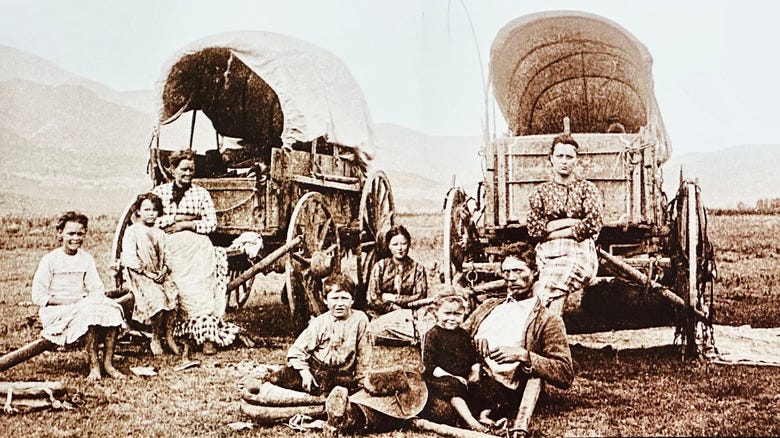
The TV series 1883, the origin story for the Yellowstone series, recounts the journey of the Dutton family from Texas to Montana. A journey where most of the travellers don’t survive and those that do are scarred by the experience. The process of migration is fraught with exploitation, robbery, murder and rape. Migration stories, in the end, boil down to survival because they are written by those who survived. But:
“Data from over 100,000 4Mi surveys with refugees and migrants on the move, reveal the risks they face, the lack of protection and the support they need on mixed migration routes. People on the move report widespread dangers, including physical and sexual violence, robbery, detention, exploitation, illness and even death – with abuses committed by both state and non-state actors, including smugglers. At the same time, people highlight needs such as cash, shelter, food, health care, water and access to work or legal aid. These risks and needs are not the same for everyone: they differ by gender, age, sexual identity, nationality and by the route taken.”
All this raises a question about what appears to be a greater tendency to violence among migrants. Are violent men more inclined to migration, are those who survive the ones prepared to be violent, or does the process of migrating lead to people being more willing to use violence? Does the process of migrating suit the mad and bad better than the kind and sane?
Travel may broaden the mind but, unless we are unusual, the process of travelling is stressful. Even something as mundane as taking a package tour to the Costa del Sol contains a host of moments when something can go wrong. Where did you put your passport? Will the taxi arrive on time or even arrive at all? Have you packed everything you need? Will the plane be delayed? Are they going to search your baggage and, worse, is that suitcase you put into the hold going to arrive at the destination with you - in one piece? Mostly none of these things happen and the worst part of travelling is the fat man in the next seat or the crying baby across the aisle.
Imagine now that your journey doesn’t start in a pleasant suburban home but in a makeshift cabin on a refugee camp just across the border from some or other civil war, famine or natural disaster. And that the cost of the journey ahead of you wasn’t paid to an airline or package tour company but to an anonymous network of men you don’t know who promise to get you to your chosen destination in England, Germany or Holland. Plus, of course, the money to pay this anonymous network consists not just of all your savings but the family’s savings, all of the spare cash from your father and mother, brothers and sisters. The hope from this payment is that you’ll reach the destination and obtain the money to repay your family and more. Better still their prayers are that they’ll join you at that destination.
You don’t start the journey in an Uber, at best you’ll be on a bus or crammed with eight others in the back of a twenty year old Toyota Hilux. But you could start off just walking with a bag full of your stuff slung over your shoulder, a cheap mobile phone in your pocket, some documentation and a little cash in your shoe - not much else. You get to stage one in this journey, somewhere by the sea where you expect a contact will get you onto a leaky boat along with a hundred others. There’s a chance that there isn’t a boat, there never was a boat, the anonymous network just swallowed your family’s money. And there’s no ABTA, no airline compensation system, you’re just a thousand miles from home with not much money.
Some give up at this point, perhaps returning, maybe hunkering down in the port looking for menial work, giving up on the chance of reaching the chosen destination. Others continue the journey, perhaps the more persistent, the angriest or the ones prepared to join others using violence or threats of violence to force the men with boats to take you. The camp by the sea is supposed to be supervised by some or other aid or refugee agency but the truth is that, just like the refugee camp where you left your family, the camp is controlled by hard men with clubs, even guns. You can either pay these men or work for these men - or get beaten up, robbed, even killed.
Every step of the journey threat and risk hangs over you. You’ll sleep in the open praying that the men you’re walking with don’t rob you in the night. Sometimes you get a roof over your head: a police cell or hard floor of a barrack room where you’ll be interrogated, slapped and poked with guns. Again money or co-operation - sometimes unpleasant co-operation - gets you away from this. By now you’ve acquired a knife providing a little more protection.
For the luckier travellers this journey might take a few months but for others, where the people smuggling network was broken or never existed in the first place, getting to an HMO in Basingstoke can take over a year. And it isn’t over then because, as you negotiate the reality that your new neighbours don’t want you there, you also find out that the once anonymous ‘travel agent’ is now a violent Albanian gangster. You’re going to pay him back before ever you get to pay your family back.
The story above may be fiction but we know that refugees and asylum seekers are five times more likely to have mental health problems compared to the wider population. King’s College London report data showing that 61% of asylum seekers “experience serious mental distress”. And because most asylum seekers given stability, security and a path to integration will recover their mental health, we can surmise that much of this mental health stress is a consequence of circumstances - why they are here and how they got here. In Britain, while asylum seekers can register with a GP and receive support, we offer no specific screening or psychoanalysis for new arrivals. Public authorities make no attempt to find out who among these recent arrivals are the mad or the bad.
It isn’t racist to make the assumption that nearly all of the people arriving on our shores as asylum seekers or refugees have some form of mental stress and that many have serious mental health problems. Being mentally ill doesn’t, obviously, mean that a person is automatically inclined to violent rage but we know that PTSD is associated with violence. So screening for PTSD might help reduce levels of violence among traumatised refugees and asylum seekers. What this suggests is that the current practice of distributing asylum seeking arrivals across communities is neither fair to those communities or fair to the asylum seekers themselves. Regardless of measures to reduce the flow of new undocumented migrants, it does seem sensible to make provision that secures communities from risks consequential on poor mental health and to provide therapy and medical support to those seeking asylum or refugee status. At present we do neither of these things.
What I’ve written here isn’t intended as an argument for or against migration but rather that, regardless of the numbers involved, we have too few support systems for migrant health and too little regard for community safety in the management of undocumented migration, asylum and refugees. We know, and public authorities know, that the extreme trauma of many migrant journeys raises the risks of violent responses from mentally ill migrants but seem to limit any response to researching migrant health rather than robust interventions of support and protection. What little support is given comes from refugee charities not the system itself. Put simply our system of managing asylum and undocumented migration fails both British communities and also the migrants themselves.
"What little support is given comes from refugee charities not the system itself. Put simply our system of managing asylum and undocumented migration fails both British communities and also the migrants themselves."
The responses to this piece illustrate the impossibility of developing an actual system for accommodating migrants. Any statement, suggestion, or observation is met with "You're a racist!" or is similarly disconnected from the topic....so nothing happens.
Successful solutions to problems need dissections of said problems before satisfactory solutions can be developed. Shouting down discussion...any discussion of any element... is so much of the "progressive" game plan, it's no wonder there's no intelligent public discourse. Anyone with an observation or idea is more likely to censor themselves than to say what they're thinking...so nothing happens.
Arendt observed that the advantage fascists of the 30's had was taking any fact and subverting it with a motive, thereby turning said fact into a morality play instead discussing the effects of the fact. C.S. Lewis wrote eloquently of "the Devil" using distraction to keep actual issues off the table and keep people arguing. Distraction. It works.
We've been here before. It's all been said before, but no one was listening so it all has to be said again.
"Put simply our system of managing asylum and undocumented migration fails both British communities and also the migrants themselves."
Why do we have a system at all? There are no war torn countries around us, just advanced Western societies. Why should (genuine) refugees be allowed to choose which country they migrate to?
Migration, legal and illegal, is a net cost to the public purse of billions of pounds something we have never voted for.
Our 'compassion' is Darwinian, given only to the strongest who make it here. In Sudan, The Congo and elsewhere there are hundreds of thousands of people (or more) no less deserving of compassion. Should we bring them all here? Is there an upper limit to how many we can accommodate?