

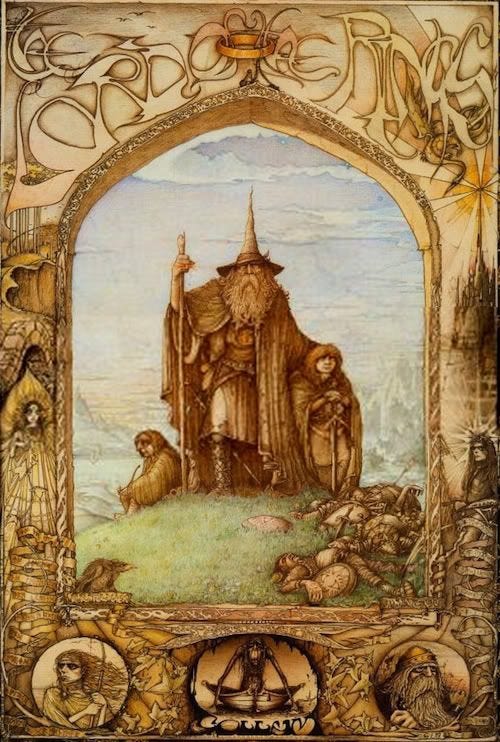
“One tiny Hobbit against all the evil the world could muster. A sane being would have given up, but Samwise burned with a magnificent madness, a glowing obsession to surmount every obstacle, to find Frodo, destroy the Ring, and cleanse Middle Earth of its festering malignancy. He knew he would try again. Fail, perhaps. And try once more. A thousand, thousand times if need be, but he would not give up the quest.”
This last week marks the anniversary of the death of the man who wrote the most important 20th century work of fiction. I’m careful here to use the term important rather than greatest or best-written despite my personal view that the book in question is also the greatest 20th century work of fiction. Importance is measured by the scale of the social, cultural and even political reach of a book. And JRR Tolkien’s “The Lord of the Rings” had a bigger cultural and social impact than anything else written in the 20th century. In the wider field of arts perhaps only The Beatles had a comparable impact on everyday cultural lives.
You don’t need to love “The Lord of the Rings” to appreciate its impact. You can believe that Tolkien nicked the story from Wagner (a bit of a stretch but the controlling ring is a big crossover), or that it is simply a children’s story made into a cult. But you cannot deny that the simple story of a great quest, a battle between good and evil and the triumph of ordinary little people, literally little people in the book, informs and influences such a lot of modern thought. From the environmental movement to anti-globalist conservatives and Big Tech billionaires the redemption of middle earth through the destruction of an over-powerful ring provides a guide.
This all struck me hard when the prime minister of Italy, at the very moment of reaching power, referenced Tolkien saying she “didn’t consider the Lord of the Rings to be a fantasy”. Now while the Italian right shares a love of Tolkien with Peter Thiel and the US techbro brotherhood, there’s an interesting difference. For Giorgia Meloni and the post-fascist right in Italy the inspiration is the hobbits and especially Sam Gamgee (not some sort of imagine race politics as her critics claim), whereas the occasionally libertarian but mostly authoritarian ‘effective altruism’ movement in America’s tech world is obsessed with the symbols of power, with the palantir, the sword that was broken and with the Simarils that caused all the bother in the first place. I’m pretty sure Peter Thiel would have done the full Isildur with the One Ring.
I’ve strayed a little here but the use of Tolkien as a cultural reference point is enormously important. You only need to read the book to appreciate why, just maybe, a palantir might not be as innocent and independent as you think. We aren’t all Aragorn after all.
Led Zeppelin’s fourth album (untitled like the previous three but called Led Zeppelin IV by everyone) is most noted for “Stairway to Heaven” but also includes “The Battle of Evermore”, featuring the wonderful Sandy Denny alongside Robert Plant. It’s an homage to “The Lord of the Rings” complete with ring wraiths and reminds us that 1970s progressive rock is replete with folk music and fantasy references. Even Caravan’s drugged up “Land of Grey and Pink” (where boy scouts stop to think) tangentially reflects this obsession. The idea of noble elves, greedy but good dwarfs (or dwarves if you are Tolkien) and a fight to stop bad people killing trees made for a perfect hippy rallying point.
We have control-crazed Silicon Valley techbros branding their products as Tolkien’s swords and crystal rocks or hippies wearing yellow boots while singing “Old Tom Bombadil water-lilies bringing, Comes hopping home again. Can you hear him singing? Hey! Come merry dol! derry dol! and merry-o, Goldberry, Goldberry, merry yellow berry-o!” But the deeper truth is that “The Lord of the Rings” isn’t about kings, swords, battles and heroic men on horses. Nor is the “Lord of the Rings” about skipping up the Withywindle in yellow boots. The book is about the heroism of ordinary men. And that’s why Sam Gamgee is the real hero of the book. That’s what Giorgia Meloni understands and Peter Thiel doesn’t: the heroes in our world, and Tolkien’s, are living next door doing mundane, ordinary jobs. Cutting grass, fixing walls, painting fences. Tolkien knew, he’d seen it in Flanders, that ordinary people did extraordinary things. And, just as importantly, returned from those extraordinary things to their mundane, ordinary life as if nothing had happened.
The “Lord of the Rings” influenced so much. The world of gaming is filled with high fantasy because of Tolkien. A simple idea of individual combat in ancient wargaming became Dungeons and Dragons but the resulting game was infused with Tolkien’s (or maybe ancient mythology through Tolkien) creations: elves, dwarves, orcs and half-orcs and, of course, halflings or hobbits as they’d have been called if 20th century copyright didn’t prevent it. And Dungeons and Dragons set the tone, helped set the systems for computer gaming. Tolkien went online.
It doesn’t matter that the creators of Dungeons and Dragons plundered Fritz Leiber, Jack Vance and Michael Moorcock because all of those writers nodded in respect or (for Moorcock) distaste to Tolkien. Why? Because the genre, the intellectual space, in which they wrote was created by Tolkien. Long shelves filled with fantasy literature - David & Leigh Eddings, Ray Feist, John Gwynne, Karen Miller, Brandon Sanderson - exist in large part because of “The Lord of the Rings”. And the idea of a mapped fantasy world went from books to film and TV. “Game of Thrones” is as unlike Tolkien’s great book as its author, George R R Martin, could manage. But it still had an existential and evil threat to the world - “Winter is Coming” - and a recognisable mix of magic, dragons and war.
Gaming is a huge industry with Tolkien’s imprimatur. Because of Dungeons and Dragons, fantasy role playing became a huge part of the gaming world from straight D&D transfers like Baldur’s Gate to games like The Witcher. The idea of a quest, of the struggle between good and evil, law and chaos became central parts of the gaming world. In the 1980s Games Workshop launched Warhammer, the hugely successful tabletop game. And the first edition of the game featured elves, dwarves, halflings, humans and orcs. If you made a fantasy setting for your story, film or game it was almost a requirement to have this mix of characters! Warhammer’s lore evolved into a reflection of Michael Moorcock’s law versus chaos but, regardless of Moorcock’s characterising of “The Lord of the Rings” as “Epic Pooh”, there’s no question that some of his literary success rode on the shoulders of Tolkien.
For fantasy writers there are, it seems, two routes: echo Tolkien’s epic quest or try to make your story as far removed from Tolkien as possible. Writers like Moorcock, Martin, Joe Abercrombie and Steve Erikson distanced their work by making characters more morally ambiguous but they still write in a fantasy setting that barely existed before “The Lord of the Rings”.
The cultural importance, especially in literature, of “The Lord of the Rings” is hard to deny. But the defenders of high culture dislike this because Tolkien’s work is genuinely popular. Over 500 million copies of “The Lord of the Rings” have been sold and familiarity with characters like Frodo, Sam and Gandalf is high. YouGov polling shows that 95% of those polled knew of the book, higher than any other work of fiction. In 2003 the BBC’s “Big Read” used public votes and the commentary of expert defenders to choose Britain’s best book. The look of disappointment on presenter Clive Anderson when he announced “The Lord of the Rings” as the winner remains one of my favourite TV moments and generated this priceless comment:
“Somebody said that The Big Read was not just un-literary but anti-literary and I think that’s right,...It is based on the assumption that the opinion of the public is always beyond reproach.”
The latest attack on Tolkien returns us to the political world where the ‘Research Information and Communications Unit’ (RICU) at Britain’s Home Office “...warns radicalisation could occur from books by authors including C.S. Lewis, J.R.R. Tolkien, Aldous Huxley and Joseph Conrad. I kid you not, though it seems that all satire is dead, but the list of suspect books also includes 1984 by George Orwell.”
Conservative writers now routinely cite Tolkien as an influence and “The Lord of the Rings” as an important conservative book. This might explain the Home Office’s concerns although it probably has more to do with Fratelli d’Italia being big on hobbits. Tolkien would have been a NIMBY but he also hated the idea of ‘the state’ and the manner in which industrialisation made everywhere less green and more unpleasant. Like lots of rural and suburban Tories I’ve a feeling Tolkien would have a soft spot for the Greens, or at least the bits of that movement which wants to save bats or newts, clean up rivers and plant more trees.
Without setting out to do so, Tolkien changed the literary world by creating, from the mythology and languages he loved, an entirely different kind of book. And that book inspired a renewed cultural appreciation of fantasy, folklore and the old world of pre-Christian Northern Europe. But “The Lord of the Rings” also told a great story that works everywhere because it is about saving the world from evil and that ordinary people, just as they did in the 1940s, did extraordinary things in the process of completing the quest.
The story isn’t about great warriors or mighty wizards wielding great power but about the heroism of people who’d done nothing much beyond gardening, going for walks and eating more than one breakfast. Indeed the great warriors and mighty rulers, we’re reminded by Tolkien, are eminently corruptible by things of great power like the palantirs. The heroes of Tolkien’s book are relatable. They may be four foot tall with hairy feet but they feel like us, like the men of WW2 whose obituaries we still read. Men who went to war, performed incredible acts of selfless bravery, then returned to being accounts clerks or gamekeepers and never mentioned the war much again.
It is this that means the book still resonates and, maybe, why there has always been a slightly elitist group who want to deny the possibility of individual heroism who resent the success of “The Lord of the Rings”. For me the book changed everything, reminded the world that storytelling matters more than great prose or elaborately nuanced characters, and above all put courage back where it belongs as one of the greatest virtues. And we should remember that even if Frodo hadn’t reached the cracks of doom - Sammath Naur - he’d still have been a hero, albeit an unremembered one.
https://paulspooner2.substack.com/p/the-gardener-who-saved-the-world?utm_source=share&utm_medium=android&r=7lg80u
I think a lot of this stems from the whole orcs are racist controversy within D & D. This seemed to me to be more a comment on the racism of those who saw orcs as an ethnic underprivileged group than any racism on the part of Tolkien. I imagine C.S. Lewis is now considered racist because he was an outspoken Christian.