

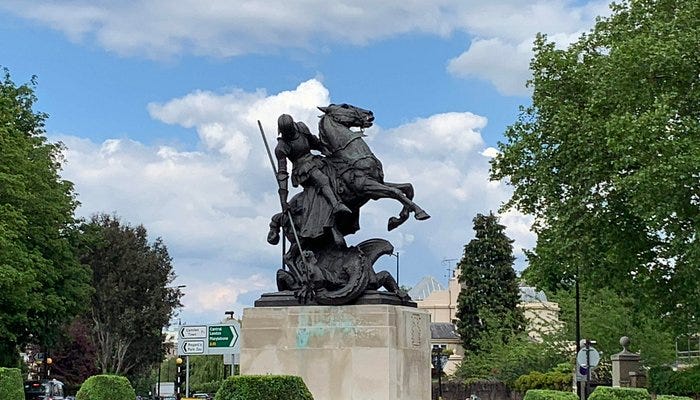
There is a glorious and passionate left-wing tradition in English folk music. From Billy Bragg’s remembering of Diggers and Levellers through the seemingly vast Kettle family giving us Merry Hell, to the traditional songs of John Spiers and Jon Boden. There has always been the idea that folk music is the music of the people, of the ordinary man, not a carefully curated presentation dished up by the posh for the bread and circuses of the poor. Because the songs, many carefully collected by the likes of Gustav Holtz and Ralph Vaughan Williams, were the songs of ordinary people, they were songs about the lives, loves, losses and laughter of those ordinary men and women. At the same time, in the secular meaning of the word, the act of preserving and celebrating folk music, however radical it may feel, is profoundly - literally even - conservative.
Among that part of the left (let’s face it, not a big part of the left) with a passion for folk music there is often a search for radicalism, a political relevance that isn’t really present unless you put it there:
“...folk music has too much of what I call ‘Billy Bragg Syndrome’, a desperate urge to be politically relevant, radical and edgy, to escape from that Ralph Vaughan Williams, Thomas Hardy and Cecil Sharp conservatism (literal conservatism - the saving and conserving of traditional song and dance). In part this latter problem merely reflects the former problem by suggesting that your nerdy love of old tunes is made relevant by talking about Gerald Winstanley and The Diggers or getting some African drummers to ‘reimagine’ ‘On Ilkley Moor’.”
One of the left’s problems with English folk customs and traditions isn’t them seeing such things as a bit twee but rather an ongoing trepidation where, if they recognise the importance of symbols like the flag of England or St George as the national patron, they will somehow be endorsing their favourite boggart, a thing they call “the far right”. Writer, broadcaster and DJ Zakia Sewell has made it her mission to lead the charge, through the medium of folk tradition, against this terrible boggart:
“Finding Albion looks to history to help undermine attempts by far-right groups to co-opt traditional symbols and stories to fuel division. “Many of our national symbols in England aren’t rooted in English soil at all,” Sewell says, noting how England’s patron saint, St George, never set foot in England and had Palestinian roots. And St George’s cross, the national flag, originated as the flag of the Italian Republic of Genoa. “The English even paid Genoa a tax for many centuries for the privilege of using the flag,” she says.”
Sewell tells us that we should come together in rejecting the “stories of Britain that are enmeshed with military, monarchy and empire” and instead adopt a different storybook based on a modern invention, the supposedly Pagan calendar. We should do this because, I assume, singing “Over the Hills and Far Away” is somehow an endorsement of the king and the army. Or even that the idea of monarchy is a bad one, that armies and navies are some sort of oppression, and that we shouldn’t remember those who served king and country. Worse, for the likes of Sewell such remembering and tradition is ‘far right’. You feel almost that bowing our heads on the 11th November isn’t an honest, decent act of remembrance but instead an act endorsing ‘military, monarchy and empire’.
The worst aspect of Sewell’s reimagined, almost expropriated folkiness, is her ‘well, actually you know’ story about England’s flag and patron saint. This suggests to me that Sewell wants to be selective about what traditions are acceptable and which traditions should be ignored. Yes she wants morris dancing and local folk traditions (but suitably bowdlerised so as not to offend) while at the same time sneering that St George had “Palestinian and Turkish roots” and that England rented the flag off Genoa. It seems necessary to point out that neither Palestine nor Turkey existed when the probably Greek speaking St George was slaying dragons. Also the English paid Genoa to protect its merchant ships in the Mediterranean not simply to use the flag. Once the Genoese couldn’t do this any more England stopped paying. Sewell’s stories may sound nice but they are still, nothing wrong with this of course, just modern mythology designed as a slightly pathetic barb at her favourite boggart, ‘the far right’.
If you go to Halifax there is a wonderful memorial to the men of the Duke of Wellington’s Regiment. The monument features the face of the Duke himself as well as soldiers from the regiment’s history: from 1760 before it adopted the Duke’s name, a soldier of the 33rd Regiment of Foot who fought at Waterloo, an officer from the great war and a man from today’s regiment. It is wrong to tell us that the 205,000 men who served in this regiment aren’t part of Halifax’s local tradition or that them marching proudly through Bradford is somehow ‘far right’. No, the Havercake Lads are rightly celebrated for their heroism, sacrifice and honour. Keighley’s brewery Timothy Taylor gives us Havercake Ale each year to remember this and we shine a little light on a few heroes of Waterloo where the terror of Napoleon was ended.
Trying to expunge war, army and navy from England’s folk tradition, what Sewell’s mission seems to want, is to cut out so much that’s important in that folk tradition. We cannot deny that men went to war, fought with Henry V, with Drake, Marlborough, Nelson and Wellington. Nor can we deny that those men, and very often the women they left behind, are right near the heart of England’s traditions. We don’t know the names of those men, they are, as Kipling said “...mere uncounted folk, Of whose life and death is none, Report or lamentation”. But through music, verse and the traditions of England those men and women are remembered.
Willie Smith’s me true love’s name, he’s a hero of great fame
He’s gone and he’s left me in sorrow, it’s true
No-one shall me enjoy but me own darling boy
But yet he’s not returning from the plains of Waterloo”
“Well, if Willie Smith’s your true
Love’s name, he’s a hero of great fame
He and I have been in battle through many’s the long campaign
Through Italy and Russia, through Germany and Prussia
Oh, he was me loyal comrade through France and through Spain”
“Until at last by the French we were surrounded
Like the heroes of old we did them subdue
We did fight for three days until we did defeat him
That brave Napoleon, bonny, on the plains of Waterloo”
I doubt June Tabor sees herself as far right but in singing this song she celebrated the great victory over Napoleon and, as so often with folk, leavened this with the sadness of loss and the terrible cruelty of war. To deny this aspect of our history, to dismiss our flag and our patron is to deny so much of what made England. It is true that the land was made by Hobdens but it is equally true that the men who fought and sometimes died in England’s colours, who served Elizabeth, George and Victoria also made England.
If you want to deal with the racists who lay claim to our flag and patron with bad intent, then the way to do this isn’t to attack the idea of the flag or the person of the patron but to pick them up, hold them high and, as Steve Knightly wrote, proclaim “I’ve lost St. George in the Union Jack, It’s my flag too and I want it back”. You don’t exclude St George, you do what we did in Bradford and you put on a parade with the symbols of the city as well as the saint and his dragonish foe. Take flag and patron into primary schools, teach their history including Agincourt, vanquishing the Armada, Waterloo and D-Day, say that this is their country and that the men who wore those colours and invoked the spirit of St George are what made it a great place.
I like, despite the fake paganism, Zakia Sewell’s desire to keep those ancient traditions (and some not so ancient) and better still to get us involved with them. But we can do this as well as flying the flag of St George, celebrating king and country, and remembering that the great land where we are so fortunate to live didn’t happen by accident. It happened because of many things - trade, innovation, genius - and one of those things is that men fought to keep the land they call home free. Denying this is an insult to England.
When I was on patrol on a submarine, we had a few guitar players who would play folk songs every Saturday night. Everyone knew the Scottish and Irish songs but only a few of us knew the English songs. I found that very sad. It will be sadder still when all our remaining folk memories are gone.
How do you feel about “Heart of oak” within this tradition? Or even fiddler’s green?
On a wider point without nourishment folk traditions die. Is this not a natural process as the stories and tales change/evolve/disappear when they no longer speak to the culture?