

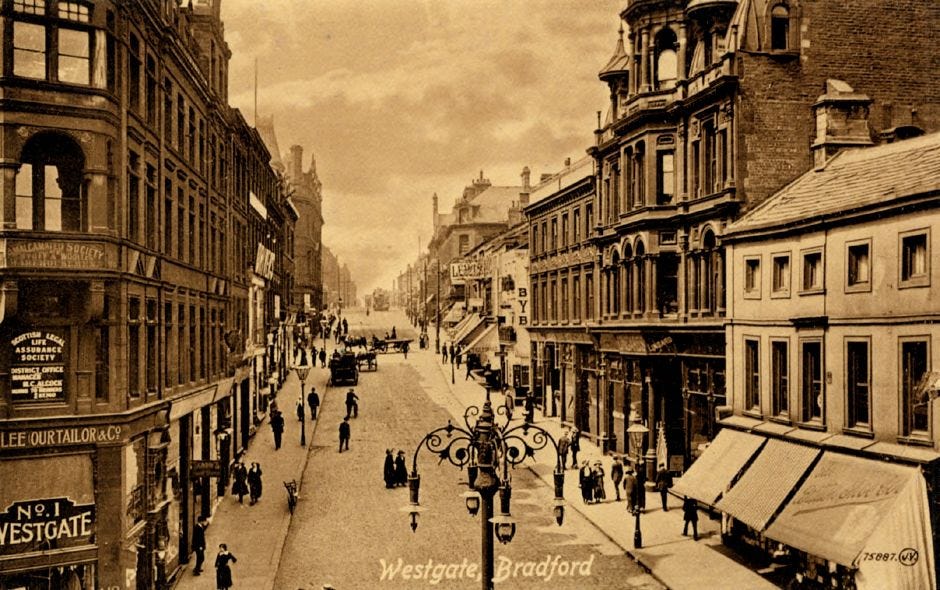
“What was once, as my boss put it, “the richest city in the richest county in the richest country in the world” is now a sorry place where the city centre, those parts of it that aren’t empty and boarded up, provides a shopping offer suited to the poor, old, tired and ill that you see walking that centre’s streets. The council and other bodies have, over the last thirty years or so, poured huge amounts of public money into seeking to turn round the City’s fortunes. Any visitor to the City would be forgiven for assuming that no investment has taken place over those years.”
I wrote this two years ago about Bradford but, if you’ve had your eyes open, you’ll recognise in these comments the sad reality of what we chose to call ‘regeneration’. For nearly 50 years now Britain’s national governments have poured cash into programmes designed to avert, turn round, the decline of places just a bit too remote from the minds of policy-makers in London to benefit directly from that great city’s success. There have been, in broad terms, three types of central government regeneration programme: Shiny Boosterism, Hugging Communities and The Big Party.
Shiny Boosterism is the most recognisable type of regeneration, we see it in Andy Burnham’s ‘Manchesterism’, in the endless obsession with trams, concert halls and shopping centres as the means to transform the lives of Britain’s left behind. The idea is that we use public money to sponsor physical development. Sometimes this takes the form, as for example with Bradford’s excellent City Park, of better public realm but more commonly it involves the underwriting (through direct grants, loans or loss guarantees) of private property development. The rationale for this strategy contains two elements: a ‘field of dreams’ idea that shiny new development will begat more shiny new development that doesn’t need public subsidy to happen, and the concept of agglomeration where the very fact of dense city environments sparks, by some magical process of interaction, economic growth.
For every example of success (and there we talk almost exclusively of Manchester) from this Shiny Boosterism we can find a dozen or more examples where the expensively subsidised new development or extravagant public realm did nothing to change the economic realities of places. Wolverhampton, Stoke, Hull, Bradford, Wakefield, and Liverpool have all had plenty of this boosterism without, if we’re honest, any noticeable boost to these places’ economic performance. Paying the profit margins of developers to attract them to your town seems like a good idea (certainly politically - all those lovely cranes) but if you take a moment the reality is that the beneficiaries here are men like Daren Whitaker rather than the local economy. When I look at the developments in Bradford delivered using this model - a half empty cinema/leisure complex, a pretty but badly built block of ‘luxury’ flats now filled with recent migrants, an uninspiring block of mostly unoccupied ‘Grade A’ offices across from City Hall - I wonder where the developers are now? They certainly aren’t in Bradford and the sloshes of public money used to ‘lever in’ investment are, I fear, mostly paying the rent on Monaco penthouses and the leases on swish supercars.
In the second part of the 1980s some regeneration folk began to question the Shiny Boosterism approach arguing (correctly) that it did nothing to help the most deprived places, the poorest people. We needed to change the emphasis of regeneration to focus on people and communities rather than physical investment. Yes there’d still be physical programmes but they’d be about creating opportunities for the inhabitants of those most deprived places. Programmes like City Challenge and its successor the ‘single regeneration budget’ (or SRB as we lovingly called it) were created that focused on poor communities rather than town and city centres. Funding was directed to social programmes (often supported by EU funding like ERDF and ESF) that spoke of skills, capacity building, ‘breaking down barriers’ and access to employment. Inevitably these schemes became filled with sub-Marxist ideas about the reasons for deprivation and, inevitably, a new collection of middle class expert mouths to feed. It’s not that none of these projects worked but that for every successful training or jobs programme there were three social programmes that amounted to little more than middle class professionals going into poor communities to give them a big hug and say ‘there, there’.
Capacity building and community development created a plethora of community centres, women’s groups, social outreach programmes and health promotion enterprises. Each of these organisations employed community development workers, centre managers and project leaders, nearly all of whom would get in their car at the days end to drive to their home in a place that wasn’t deprived. It wasn’t that no good was done by this Hugging Communities regeneration strategy - parks were improved, community centres did provide much needed social space and kids were helped into work - but more that so much of the cash vanished into ideologically pure projects and, in the end, the money didn’t resolve the reasons for the places being so deprived in the first place.
Some people then argued that a more ‘holistic’ approach was needed, one that combined the politically popular Shiny Boosterism with the regeneration professionals’ preference for Hugging Communities. The idea of focusing on the local economy began to develop as a strategy, promoted by think tanks like the Centre for Regional Economic and Social Research (CRESR) - full disclosure, I did my Urban Regeneration MSc at Sheffield Hallam University where CRESR is based - and the Centre for Local Economies (CLES). The core of this strategy is another economic idea, popularised by the New Economics Foundation, the local multiplier. The essential conceit of the multiplier is that the reason for deprivation is that because poor places see a net outflow of money to richer places, the response to regeneration must focus on keeping money circulating within these poorer communities. And public agencies - councils, universities, colleges - need to contribute through their procurement strategies and employment policies. If these ‘anchor organisations’, recipients of money from outside the poor area, spent more of their money locally there’d be more money in the community and the economy would grow.
There are lots of reasons why this approach doesn’t work (which doesn’t stop NEF, CLES and assorted left wing councils and MPs claiming it does) but the actual national strategy, New Deal for Communities, founded on these ideas was no more successful than earlier social regeneration programmes like City Challenge and SRB. We might as well just spend the money on a Big Party.
In the history of regeneration there’s nothing new about the idea of throwing a Big Party. You could argue that various EXPOs across the world represent using the Big Party to get some economic boost. But for urban regeneration the ‘throw a big party’ approach starts with the 1984 International Garden Festival in Liverpool. Great dollops of government cash was thrown at a derelict industrial site to put on the festival, obviously in the hope that this would stimulate a long term transformation. It is safe to say that this long term benefit (other than the remediation of a big landfill site) remains tantalisingly unrealised forty years later.
The questionable success of the International Garden Festival hasn’t stopped governments from believing that throwing a Big Party will transform struggling provincial towns and cities. Most notably there’s the Capital of Culture and City of Culture competitions that, in true Heseltine-style, got places to bid for the accolade of being the chosen city. It would be an excellent pub quiz question to name the four cities that have been UK City of Culture since the scheme was introduced in 2013 (they are Londonderry, Hull, Coventry and Bradford, Liverpool had been European Capital of Culture in 2008). But even being kind to these great cities, it is hard to see what substantive economic benefit they’ve got from their respective year-long cultural celebrations.
Throwing a Big Party does seem like a great strategy, it is certainly popular with the great and good of successful cities who get to dress up a lot and attend big events. And some of those events, magician Dynamo launching Bradford’s year of culture in a freezing cold City Park was brilliant despite the frostbite, are genuinely popular with local people. I’m sure also that there’ll be an expensively procured evaluation pointing to lots of ‘legacy’ from the year of party but has that cultural boost also boosted the economic prospects of the host cities? This is the problem - who remembers Bradford hosting Britain’s first International Markets Festival with traders from 20 different countries filling the streets of the city centre? What economic gain has Gateshead got from its long term strategy of culture-led regeneration? For sure there’s the magnificent Angel of the North but everyone thinks the Glasshouse and other Tyneside wonders are in Newcastle not Gateshead.
These three regeneration strategies haven’t worked, at least if you accept that the objective of regeneration is the long-term economic transformation of a place. England’s Northern and Midland cities have all sorts of shiny buildings, hundreds of community organisations born from SRB or NDC, and fading memories of whatever Big Party the city managed to wangle the cash to put on. But any long-term betterment hasn’t come from these programmes, it has come from the economic fundamentals changing, sometimes at the expense (as we see in Manchester) of other struggling regional towns and cities.
There isn’t a magic wand, a secret formula, for regeneration. This isn’t an argument against government, national or local, spending money on physical, social or cultural projects but one asking for more realism. And when we’ve been honest with ourselves about regeneration we should maybe ask about what makes a place successful. We can’t do much about the weather but we can think seriously about what is realistic (Hull is not going to become San Francisco) and if the regulatory environment attracts inward investment and, as importantly, supports the making of new local businesses. If the North’s (or indeed anywhere else’s) cities want to grow they need control of more taxes, regulations and rules - not so they have more money for the mayor or council leader to spend on getting re-elected but so they can reduce the negatives that those taxes, rules and regulations impose on business, investors and trade.
Bradford didn’t need lashings of cash from Whitehall to build its amazing City Hall, Cartwright Hall Gallery, and Wool Exchange, not to mention thousands of other incredible places. Or to build water works, gas works, railway stations and concert halls. Bradford built these wonders because back then it was the richest city, in the richest county in the richest country in the world. And in the Wool Exchange there stands a clue as to why Bradford got so rich, a statue of Richard Cobden, champion of free trade, free enterprise, free markets and local government. Richard Cobden the father of true Manchesterism.
The "local multiplier" seems to operate on the same logic as Donald Trump's tariffs.
Very good! You don't mention Birmingham!!!!! I wonder why!