

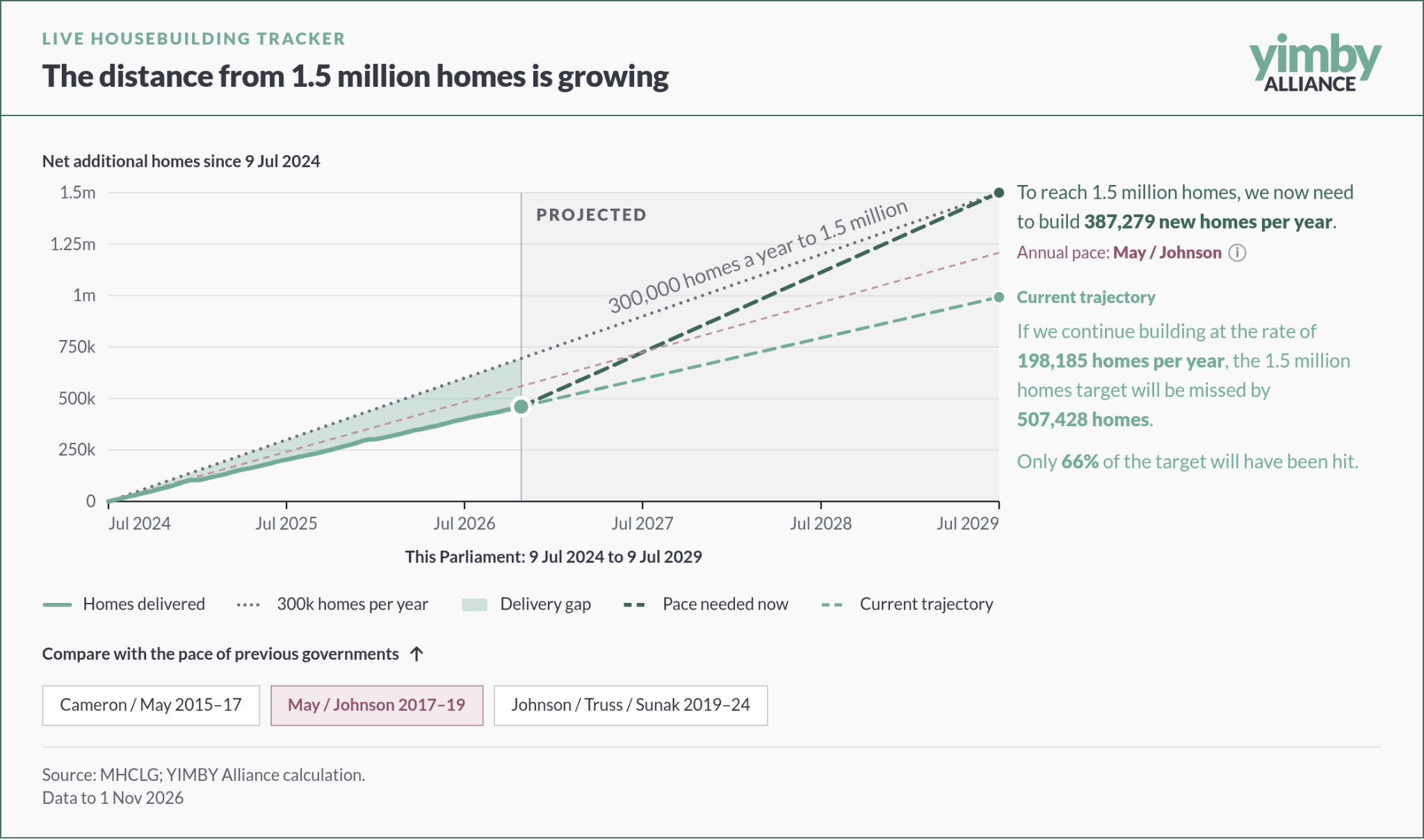
YIMBY Alliance, the Labour adjacent housing lobbyist, has launched a live housebuilding tracker and it shows that the policy adopted by Labour in 2023, positioned as a break the NIMBYs, a ‘backing the builders not the blockers’ is an abject failure. The target of building 1.5m homes in five years is dead in the water and new housing starts are at historic lows.
Back when Sir Keir Starmer launched the exciting new policy, the world of the YIMBYs got tremendously excited believing that electing a Labour government would result in a return to housing abundance as the builders built and blockers cried. The problem was that the housing policy, for all its positive sounding initiatives, was the wrong policy if we wanted to get affordable homes for British families. Some of us pointed this out at the time:
“If we want to meet housing needs, we need to start with increasing the supply of land available for development. And we need to understand that most of our planning law was introduced with the express purpose of making less land available and making development more difficult. Without substantial changes to green belt, s106, the local plan system and the incentives for people to build, there is not a hope in hell that we will get anywhere close to building the 4.3 million homes we need right now let alone the homes we might need building in the future. A serious policy intended to meet housing needs would begin with tearing up the 1947 Town and Country Planning Act and its replacement with a law that is pro-housing and pro-development.”
The problem with Labour’s policy was clear from the very start. For Labour, the ‘blockers’ weren’t local councillors using opposition to development as a vote hook. The ‘blockers’ weren’t environmental quangos and charities preventing development on specious wildlife protection grounds. The ‘blockers’ weren’t activists using the judicial review system as a de facto tax on developers. And the ‘blockers’ weren’t councils demanding unrealistic contributions from developers making more and more developments unviable. For Labour the ‘blockers’ were described in Sir Keir speech launching the now failing policy:
“Today we launch a new plan to get Britain building again. No more land-bankers sitting comfortably on brownfield sites while rents in their community rise. No more councils refusing to develop a local plan because they prefer the back-door deals.”
From the start Labour was facing in the wrong direction believing that the lack of housing developers was down to companies whose business is building houses rather than a consequence of a system designed since its inception to prevent development. The 1947 Town & Country Planning Act was created for two reasons:
To appease the Labour left who wanted complete nationalisation of land but could be bought off by the state controlling land use
To prevent what was pejoratively called ‘sprawl’ because privately developed suburbs had transformed previously Labour-voting renters into Tory supporting home owners
The problem was that those Tory supporting homeowners used the anti-development laws to, as they would put it, ‘protect’ their communities and the countryside. Opposition to new suburban development (and often any development at all) became a central political objective for every political party. And at national level housing policies became defined by a focus on cities, on urban densification, and on extending the anti-suburb ideas that informed the implementation of the 1947 Act. Architect Richard Rogers was commissioned by Tony Blair and John Prescott and produced “Towards an Urban Renaissance”, a definitive ‘cities first’ policy that became, through Planning Policy Guidance 3 (PPG3), the bedrock for New Labour’s approach to planning, housing and development. Despite the reasons being otherwise, Rogers claimed that suburban and exurban development was the reason for the relative decline of Britain’s cities. PPG3 required local planning authorities (LPAs) to apply a sequential test to development based on distance from a city centre. And LPAs were also told to prioritise the reuse of previously developed - ‘brownfield’ - land.
The result wasn’t a boom in cities or urban living but a dramatic drop in suburban development accompanied (especially given cheap credit from low interest rates) by a surge in house prices. Those suburban Tories loved New Labour as the value of their homes soared. Opposition parties - Liberal Democrat and Conservative - watched closely and decided that low interest rates combined with blocking housing development was a surefire way to win back the suburban seats they’d lost to Labour. While most voters were home owners this worked as a generation of millionaires emerged off the back of housing wealth. But the newer generations, especially anywhere near London, couldn’t afford to buy and weren’t qualified for council homes, so went back into a private rented sector that their grandparents had escaped in the 1920s and 1930s.
This is the context for the YIMBY movement (and why they are so often wrong) that Sir Keir Starmer and Labour sought to woo back in 2023. The current housing policy was born from the rhetoric of ‘generation rent’ championed by YIMBYs and contains several fundamental errors:
Despite major economic problems, the biggest transformation in Britain’s housing came with suburban development in the 1920s and 1930s. Yet YIMBYs and Labour’s policy planners focused instead on the mass council house building in the 1950s and 1960s, repeatedly claiming wrongly that this showed only the state can deliver mass housebuilding.
The policy sought to replicate the new towns policy developed in the 1940s believing this was the way to deliver housing at “scale and pace”. But the new towns programme failed, delivering too much poor housing, breaking up established inner city communities and, for some, stagnant oases of unemployment and crime.
Although the changes to green belt policy and the national scheme of delegation for planning are welcome improvements, the policy retained the belief that you could apply high levies to developments without the quantity of development being affected. The changes to green belt has freed up some more land, especially where LPAs don’t have an approved local plan, but affordable housing requirements, environmental rules and the millstone of the s106 system now represent the biggest block to development.
Labour’s policy, by stressing inner urban density, baked in renting as the default tenure for the majority of young (and not so young) urban professionals. This takes us back to the pre-1914 world where only the wealthy were homeowners - someone like Mr Banks in Mary Poppins almost certainly leased or rented his grand home, he didn’t own it.
Far too much emphasis on social, in particular council housing despite this rent controlled stock being a drag on new homes and the wider economy - the worst sort of housing policy.
Britain’s economic circumstances undoubtedly contributed to the collapse in new home building described by the YIMBY Alliance but we still have a development control system that builds in a bewildering collection of reasons why development can’t happen. The principle barrier remains land supply (and hence the value of land) but even when the principle of development is accepted, the developer has to hack their way through a forest of reporting requirements, mitigations and barriers to progress. As a result, especially and ironically with ‘brownfield’ sites, development becomes unviable for all but the most lucrative of end uses.
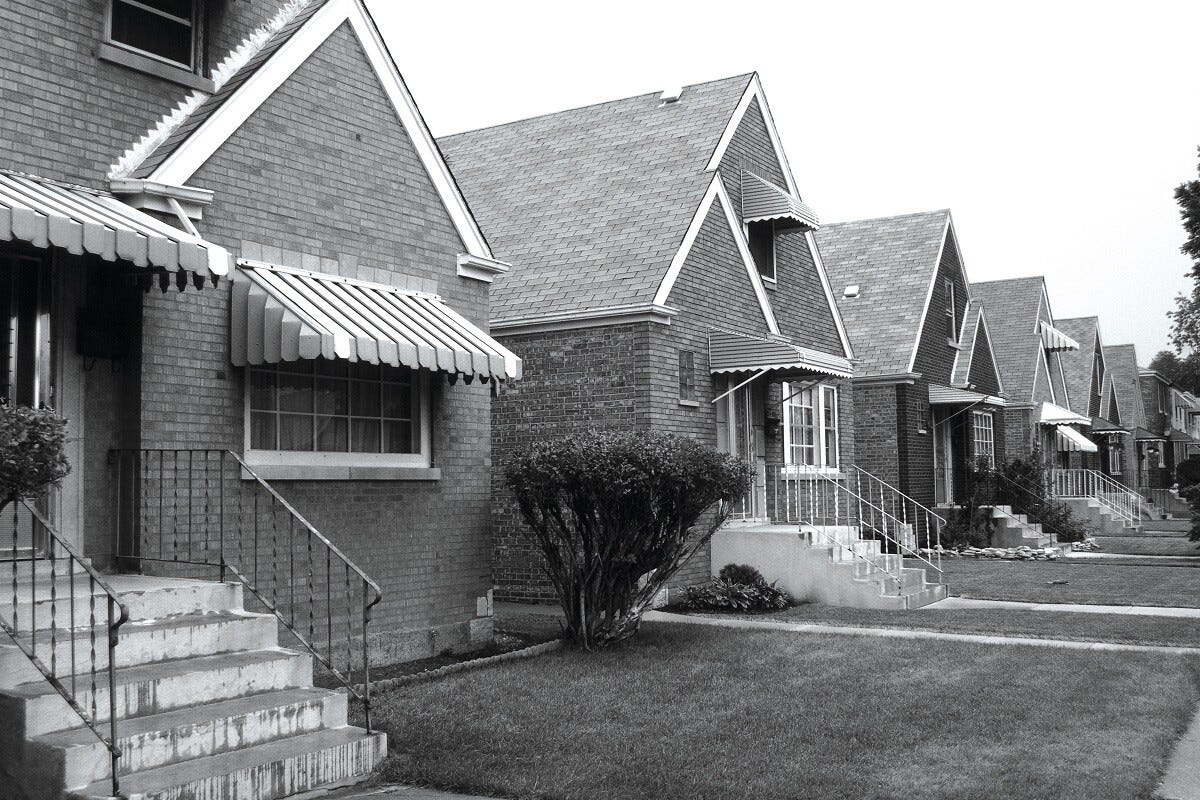
We need to turn the system upside down, to recognise that planning controls are an invasion of property rights, and to return to the idea that, if you own some land, you can develop that land. In the 1930s when Britain saw its biggest surge in housing it was almost entirely driven by speculative private development with something like 76,000 building companies creating the unique communities that are Britain’s suburbs. The 1947 Act was, with input from men like Patrick Abercrombie, designed to control and manage that private initiative, to ensure that places were “planned” rather than created organically by individual choices, investment and preference. If you want a pro-development system that allows choice and private initiative to deliver the homes people want, then you have to start by demolishing the systems of development control created primarily to crush that choice and private initiative.
The YIMBY Alliance call for more ‘planning reform’ but in doing so fail to realise that reforming the system as it is doesn’t create a pro-development system because the 1947 Act and its children were specifically designed to be anti-development. There is no good reason for your local council to decide what you can or cannot do with your own land but that is exactly what we have with planning controls keenly backed by councillors and MPs from every political party. Until this changes we will not fix our housing system, young people still won’t be able to to what previous generations did and buy a house. It’s no damned good if we can’t do what Jordan Davis’s grandpa did and buy dirt:
Find the one you can’t live without
Get a ring, let your knee hit the ground
Do what you love but call it work
And throw a little money in the plate at church
Send your prayers up and your roots down deep
Add a few limbs to your family tree
And watch their pencil marks
And the grass in the yard
All grow up”